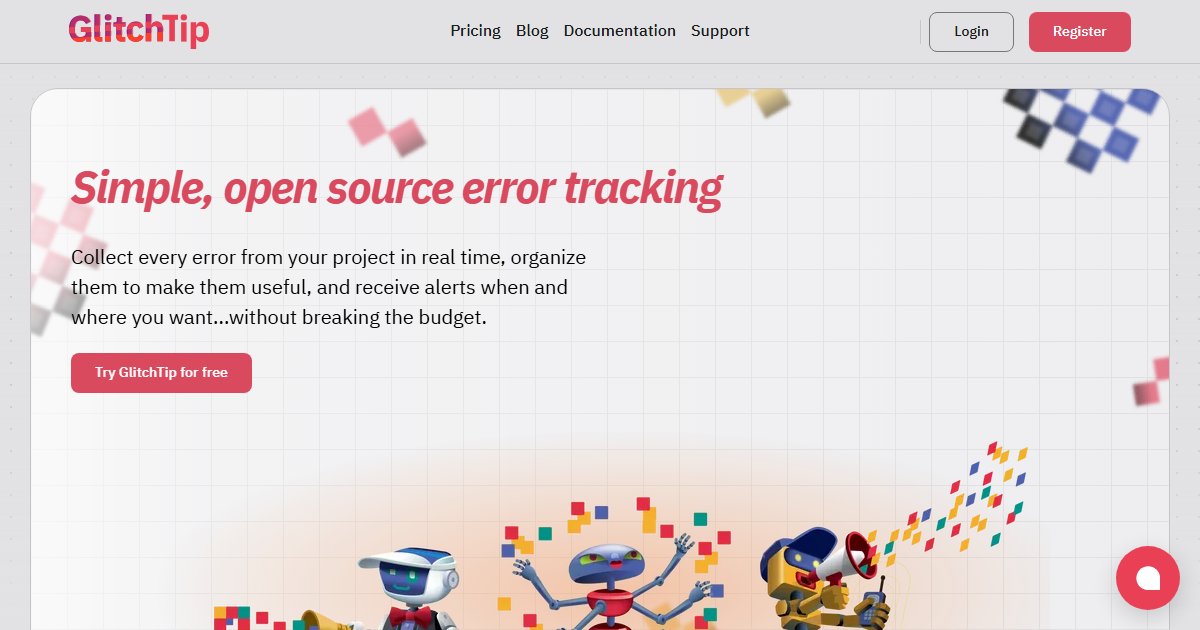
GlitchTip: Lightweight Error Tracking Compatible With Sentry SDKs
GlitchTip collects errors and exceptions from your applications and alerts you when something breaks. Its key trick is compatibility with Sentry’s client SDKs: applications already instrumented for Sentry can send to GlitchTip by changing one DSN, with no code changes.
Why GlitchTip instead of self-hosted Sentry?
Sentry is excellent, but its self-hosted version is a large stack of many services (Kafka, ClickHouse, Snuba, Redis, PostgreSQL, and more) that needs significant RAM and upkeep. GlitchTip implements the most-used parts of Sentry’s API on a much smaller stack: a Django application, PostgreSQL, and Redis or Valkey. For small teams and side projects, that difference is decisive.
Features
- Error tracking: exceptions, log messages, and security policy violations, grouped into issues with stack traces
- Performance monitoring: slow transactions and database calls
- Uptime monitoring: checks your sites and alerts by email or webhook when they go down
- Logs alongside errors
- Alerts by email and webhooks, and team and project organisation
Deployment
Run GlitchTip with Docker Compose: the web application, a worker, PostgreSQL, and Redis or Valkey. Configure a domain, an email backend for alerts, and a secret key, then put it behind a reverse proxy with HTTPS. In your application, set the Sentry SDK’s DSN to the one GlitchTip shows for your project.
A hosted version is available from the maintainers, with a free tier.
Alternatives
- Sentry: the full-featured original, heavier to self-host
- SigNoz: broader observability with traces and logs, including exceptions
- Uptime Kuma: if you only need uptime checks
License
MIT.