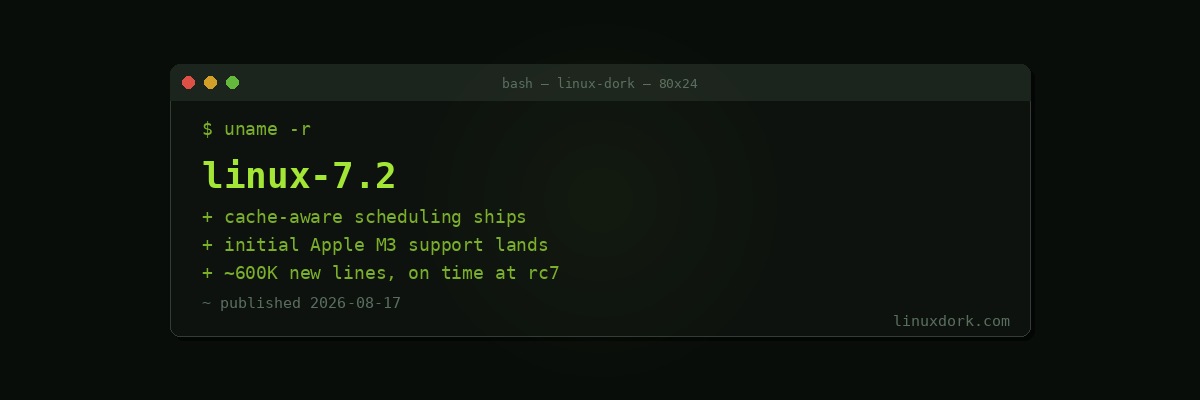
Linux 7.2 Released: Cache-Aware Scheduling, Apple M3 Support, and One of the Busiest Cycles Ever
Linus Torvalds released Linux 7.2 on Sunday, August 16, wrapping the cycle at rc7 without needing the extra eighth week of testing that had looked possible a few weeks back. The site covered the rc6 milestone earlier this month; the final release landed on the expected date, capping one of the busiest development cycles in the kernel’s history at nearly 600,000 new lines of code.
Cache-aware scheduling
The headline feature is the new cache-aware load balancing work in the task scheduler. The scheduler can now recognize when tasks share data and co-locate them within the same Last Level Cache domain rather than spreading them across cores blindly. On modern chiplet-based CPUs, where a cache miss to another chiplet is dramatically more expensive than a hit in the local LLC, this can meaningfully improve throughput for workloads with heavy inter-thread data sharing.
# See your CPU's cache domain topology
lscpu --caches

# Check which kernel you're running after upgrading
uname -r
Hardware support
Two hardware milestones stand out. Initial Apple M3 support has landed, continuing the mainlining of Apple Silicon bring-up work that has been flowing upstream generation by generation. And the AMDGPU driver gains initial HDMI 2.1 Fixed Rate Link (FRL) support, the higher-bandwidth link mode needed to drive 4K high-refresh and 8K displays over HDMI without compression tricks.
Intel’s contributions include the new USB4STREAM protocol work and initial CRI platform support in the Xe graphics driver, alongside the usual round of platform enablement for upcoming chips.
Rust reaches s390
Rust support in the kernel now extends to IBM’s System/390 mainframe architecture. This matters less for the handful of people running Linux on mainframes and more as a signal: Rust-in-the-kernel infrastructure is being treated as something every supported architecture needs, not an x86-only experiment.
Torvalds on the “new normal”
Torvalds noted in the release announcement that his own scheduling around this release reflected what he called the new normal of the kernel’s development cadence, remarks that drew some press attention about the sustainability of the release rhythm. The practical takeaway for users is simpler: 7.2 shipped on time, and the 7.3 merge window opens immediately.
When you’ll get it
Rolling distributions like Arch and openSUSE Tumbleweed typically ship a new stable kernel within a week or two. Fixed-release distributions will mostly pick 7.2 up in their next scheduled releases, and anyone can build it from source now from kernel.org.