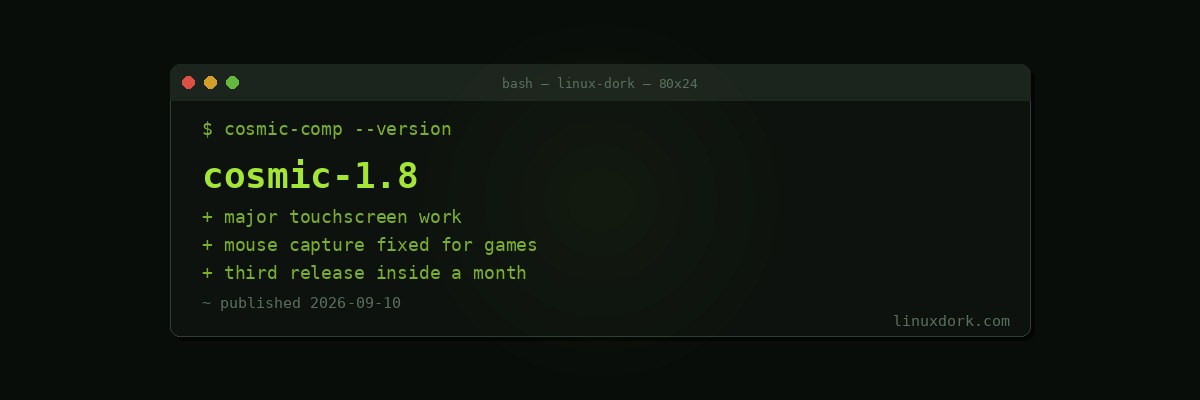
COSMIC Desktop 1.8 Improves Touchscreen Support and Steam Overlays
COSMIC Desktop 1.8 is out with substantial touchscreen improvements, better mouse capture, smoother Steam overlays, and hybrid GPU fixes.
That is the third release in under a month, following 1.6 and 1.7. The cadence since 1.0 has been remarkable.
Touchscreen support
Touch input on Linux desktops has historically been an afterthought, and it shows. Gestures are inconsistent, on-screen keyboards appear at the wrong moments, touch targets are sized for a mouse cursor, and scrolling has the wrong physics.
COSMIC being written from scratch is an advantage here. A desktop with thirty years of accumulated assumptions about pointer input retrofits touch awkwardly; one designed more recently can treat it as a first-class input method. The convertible and tablet form factors are a small slice of Linux hardware, but they are a slice that has been served poorly by everything.
Mouse capture and Steam overlays
Both of these are gaming fixes, and both are the kind of problem that makes a desktop feel unfinished.
Mouse capture is what a game does when it takes exclusive pointer control for camera movement. Getting it wrong under Wayland produces the cursor escaping to a second monitor mid-game, or input that stutters, or a pointer that will not release when you alt-tab. It is the sort of bug that is invisible until you hit it and then makes the system unusable for its purpose.
Steam overlay smoothness matters because the overlay is how you reach chat, screenshots, and the browser without leaving a game. An overlay that stutters when summoned is a constant small irritation.
Hybrid GPU fixes address laptops with both integrated and discrete graphics, where the question of which GPU renders what has been a reliable source of trouble on Linux for a decade.
Taken together these are System76 making COSMIC viable on the hardware they sell, which includes gaming laptops. It also aligns with where the desktop Linux gaming situation has been heading generally, following Proton 11.0.2 and the Steam controller driver landing in 7.3.
Where COSMIC stands
A year ago the reasonable position was to watch it. Now it is a real option, and the monthly releases are steadily removing the reasons not to use it.
The things that still distinguish it from GNOME and Plasma are ecosystem depth rather than core function: fewer extensions, a smaller set of first-party applications, and less third-party theming and integration. Those accumulate over years and cannot be rushed.
What it has instead is a coherent design, Rust throughout, genuinely good tiling built into a conventional desktop rather than bolted on, and a development pace that suggests the gaps will close.
Available in Pop!_OS and packaged for Fedora, Arch, NixOS, and openSUSE.