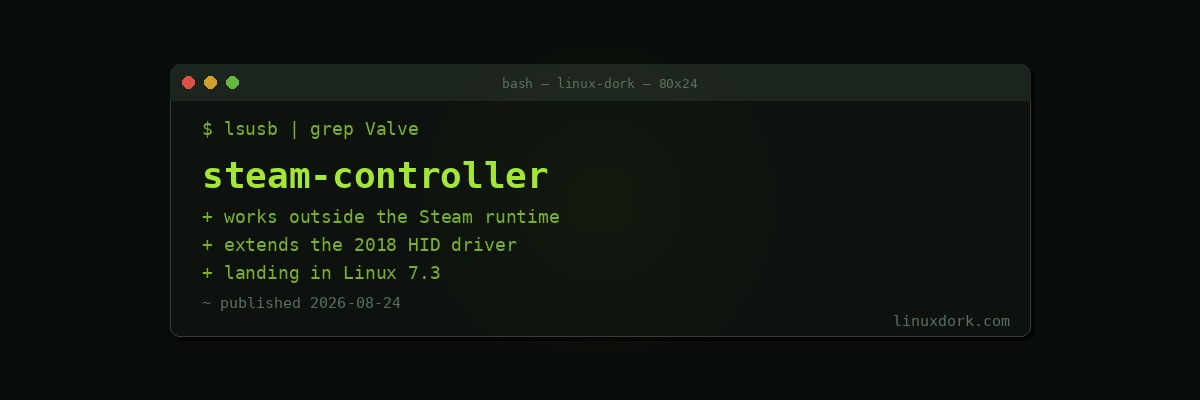
Linux 7.3 Merges Initial Kernel Driver Support for the 2026 Steam Controller
HID subsystem updates merged for the Linux 7.3 merge window include initial kernel driver support for the 2026 Valve Steam Controller.
Why a kernel driver
The original Steam Controller driver landed in the kernel in 2018, and the reasoning then applies now: it lets the hardware work as a conventional HID device, outside of software that depends on the Steam runtime or SDL.
That distinction matters more than it sounds. Without a kernel driver, a controller works when Steam is running and Steam Input is handling it, and otherwise behaves oddly or not at all. Emulators launched outside Steam, browser games, non-Steam launchers, and anything using the raw evdev interface either get nothing or get a device that reports incorrectly.
A kernel driver makes the controller work everywhere on the system, with no userspace daemon required.
Valve’s pattern
This is the same sequence Valve has followed with each hardware generation: ship the device, get support into the kernel, and let it flow downstream to every distribution on its own schedule.
The upstreaming is the part worth appreciating. Valve could reasonably have kept the support inside SteamOS, where it controls the whole stack and ships updates directly. Putting it in mainline means it reaches Arch, Fedora, Debian, and everything else without Valve doing anything further, and it means the driver outlives whatever commercial interest Valve has in the device.
Hardware vendors upstreaming their drivers rather than shipping out-of-tree modules is the behavior the kernel community has been asking for since roughly forever, and Valve has been consistent about it.
Timeline
The support is initial, meaning basic functionality rather than complete feature coverage. Advanced features tend to arrive in subsequent cycles as the driver matures.
Linux 7.3 should reach stable around October. Distributions tracking the newest kernels will pick it up shortly after; anyone on an LTS branch will wait for a backport or a distribution kernel that includes it.
Bazzite 44 and similar gaming-focused distributions typically ship newer kernels than general-purpose ones, so those are the likely first places the support shows up in practice.