Armbian 26.8 Rewrites Its Installer and Adds Bootable UEFI ISO Images
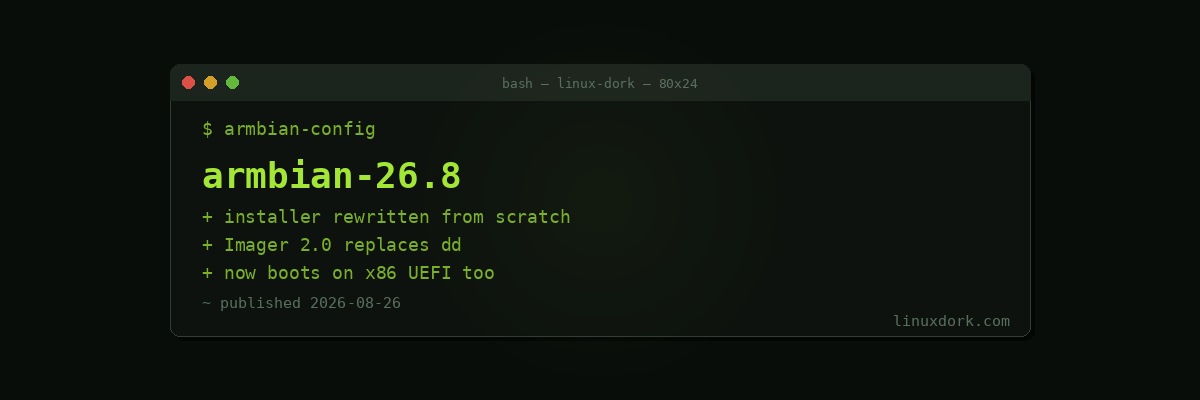
Armbian 26.8 was released on August 25 with Linux kernel 7.1, a completely rewritten installer, Armbian Imager 2.0, and bootable UEFI ISO images.
What Armbian is for
It builds Debian and Ubuntu-based images for Arm single board computers, and the value is entirely in the part nobody sees: board support.
Each board needs a working device tree, a kernel with the right drivers, and bootloader configuration. Vendors typically ship one image built against an old kernel and then lose interest. Armbian maintains current images across a very large number of boards, which is the difference between hardware that stays useful and hardware that is stuck on whatever it shipped with in 2021.
The rewritten installer
The previous installer was serviceable and showed its age. A rewrite matters here because the first-run experience on an SBC is where people give up: flashing an image, finding no display output, and having no idea whether the board booted at all.
Armbian Imager 2.0 handles writing images to storage, which is the step where dd is otherwise the tool and naming the wrong device is the risk.
UEFI ISO images
The more surprising addition. Armbian has always been an Arm project, and bootable UEFI ISOs mean it installs on ordinary x86 machines too.
That is a genuine expansion of scope. Armbian’s distinguishing property has been a lean Debian base tuned for small headless machines, and that turns out to be just as applicable to a mini PC or an old laptop pressed into service as a home server.
For anyone running a homelab on mixed hardware, one distribution across Arm boards and x86 boxes is a real simplification.
The awkward backdrop
This lands in a market that just contracted sharply. PINE64 halted production of its Linux devices on August 19, citing DRAM and eMMC shortages driven by AI datacentre demand, with nothing committed before mid-2027.
The shortage is not specific to PINE64. Every SBC maker buys from the same constrained supply at the same elevated prices, and boards in this category run on margins thin enough that component costs pass straight through.
Better software support for more boards is welcome. Whether the boards stay affordable is a question nobody in the Linux world controls.
Related
DietPi 10.6 added images for several new Orange Pi and ODROID boards earlier this month, covering similar ground with a more aggressively minimal base.