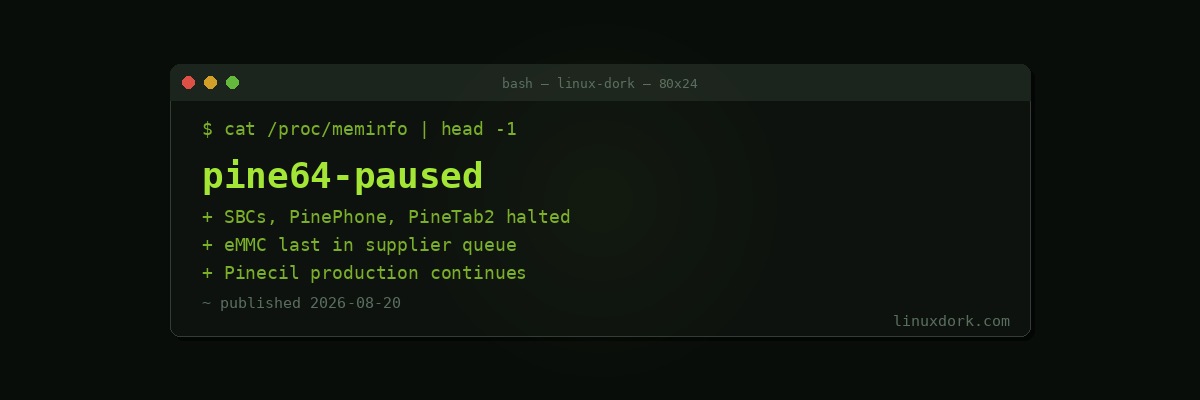
PINE64 Halts Linux Device Production Until at Least Mid-2027 as Memory Prices Bite
PINE64 announced on August 19 that it has no plans to produce additional Linux devices in the near future, blaming the ongoing DRAM and eMMC shortage. The company says future production depends on component pricing after mid-2027.
This is the largest single contraction the hobbyist Linux hardware market has seen in years, and the reason has nothing to do with Linux.
What is stopping
The halt covers PINE64’s full lineup of memory-dependent products:
- The Arm and RISC-V single board computers
- The PinePhone family
- The PineTab2 tablet
- The PineNote e-reader
Remaining PineNote and PineTab2 stock is estimated to last around three months. After that, there is no committed restock date.
What is continuing
PineTime, PineVoice, and Pinecil production continue as normal. These are microcontroller-based products that do not depend on the DRAM and eMMC supply that has become the problem, so they sit outside the squeeze entirely.
If you have been meaning to buy a Pinecil soldering iron, nothing has changed. If you have been meaning to buy a PinePhone, the window is closing.
Why eMMC specifically
The broader memory shortage has been widely reported, but the eMMC and UFS segment is in a worse position than NAND generally.
The reason is allocation. eMMC production capacity overlaps with enterprise SSD production, and enterprise SSDs carry far higher margins. When suppliers have to choose, eMMC is last in line. Demand from AI datacenter buildouts has made that choice easy and consistent.
Single board computers are exactly the wrong product for this environment. They use modest amounts of memory per unit, sell at thin margins, and ship in volumes that give the manufacturer no leverage with suppliers. A company buying DRAM for a fleet of AI accelerators is a customer worth prioritizing. A company buying DRAM for a $60 board is not.
What this means practically
If you were planning a project around a PINE64 board, you need a different plan. The obvious alternatives face the same component market, so expect price increases and availability gaps across the SBC category rather than a clean substitution.
It is also worth noting what PINE64 did not say. This is not a company shutting down, and it is not a statement that Linux hardware has no future. It is a company declining to buy components at current prices for products that cannot absorb the cost. That is a rational pause, and it is reversible if the market normalizes.
Whether it normalizes by mid-2027 is a question about AI capital expenditure, not about Linux.
The uncomfortable structural point
The Linux hardware ecosystem below the laptop tier has always depended on companies willing to operate at volumes and margins that large manufacturers ignore. That model works when components are cheap and available. It has no buffer when they are not.
PINE64 is the first to say so plainly. It is unlikely to be the last.