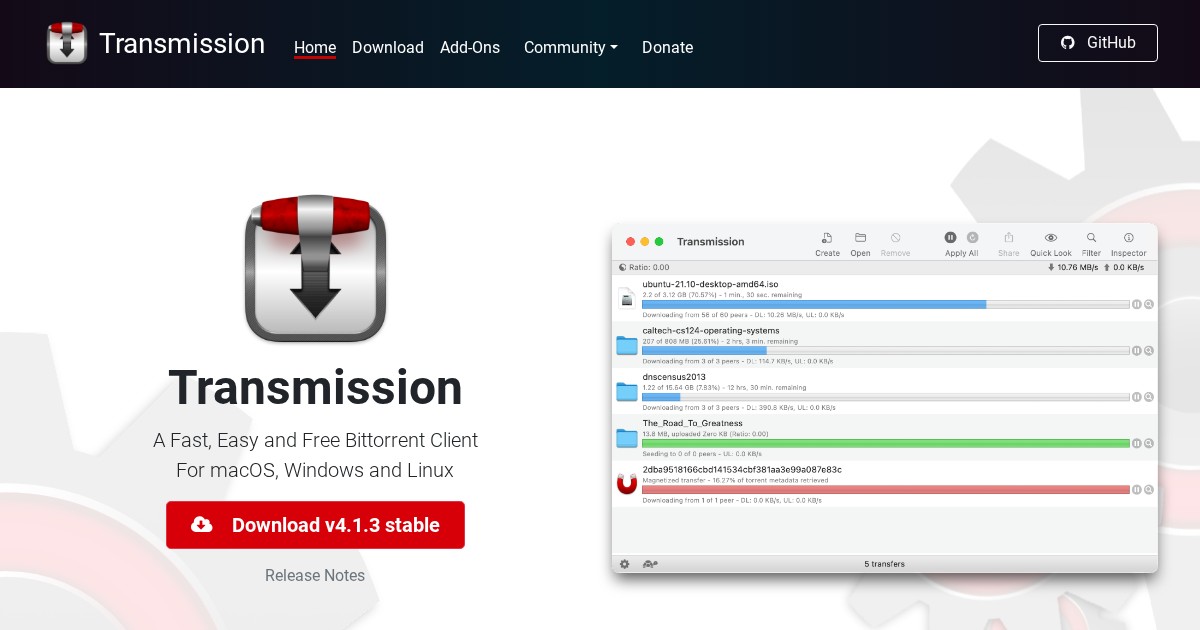
Transmission: Lightweight BitTorrent Client
Transmission is a BitTorrent client built around using as little as possible: memory, CPU, and interface.
Why it persists on small hardware
It is the default client on many NAS platforms and router firmwares because the daemon runs comfortably in a few tens of megabytes. On a Raspberry Pi or an ARM NAS where qBittorrent is noticeably heavier, Transmission remains responsive.
The web interface is spare but complete for daily use, and the RPC API is well supported by third-party tools and by Sonarr and Radarr.
The tradeoff against qBittorrent
Transmission deliberately omits features: no built-in search, limited scheduling, fewer per-torrent controls, and a simpler category model. For automated media stacks that mostly need “accept torrent, save to path, report status,” none of that matters. For hands-on torrent management with tag hierarchies and detailed rules, qBittorrent is the better tool.
Configuration notes
Settings live in a JSON file that the daemon rewrites on shutdown, which catches people out: editing it while the daemon runs means your changes are overwritten. Stop the service, edit, then start.
If you route traffic through a VPN, bind the daemon to the tunnel interface so it stops rather than leaking if the tunnel drops.
Clients
Native remote clients exist for most platforms, and the RPC interface means mobile apps and dashboards integrate easily.
License
Transmission is released under the GNU General Public License v2.0 or later.