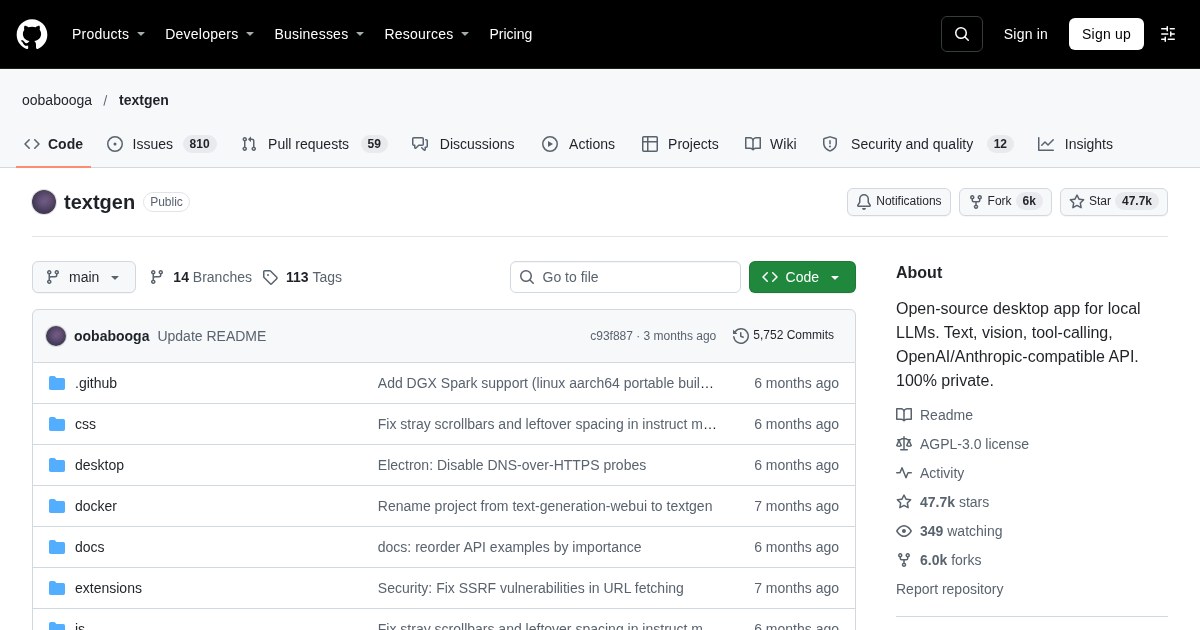
Text Generation WebUI: A Local LLM Interface With Many Backends
Text Generation WebUI, often called oobabooga after its author, is the interface for people who want to run models locally and change how.
Backend flexibility is the point
Most local LLM tools pick one inference engine. This one supports llama.cpp, Transformers, ExLlamaV2 and others, with GGUF, EXL2 and safetensors weights.
That matters when you care about the specifics: a GGUF quant through llama.cpp for CPU or modest VRAM, an EXL2 quant through ExLlamaV2 for speed on a single GPU, full-precision Transformers for quality. Swapping between them without changing tools is genuinely useful for evaluation.
Ollama by contrast abstracts the backend away entirely, which is the right call for most people and the wrong one if you are tuning.
Three modes
Chat for conversation with instruction-tuned models. Notebook for free-form continuation, which is how base models actually want to be used. Default for raw prompt-completion with full parameter control.
The notebook mode is unusual and worth knowing about: most interfaces assume a chat model and make base models awkward.
Parameter control
Temperature, top-p, top-k, min-p, repetition penalty, mirostat, and sampler ordering, all exposed. That is the reason to choose this over a cleaner interface: if you want to understand why output changes, you need the knobs.
It also exposes an OpenAI-compatible API, so it can sit behind LiteLLM alongside other backends.
Hardware
nvidia-smi
rocm-smi
VRAM is the constraint. Our ROCm and CUDA guide covers getting the GPU working and the group membership that is usually the real blocker, and our running LLMs locally guide covers model sizing.
CPU inference through llama.cpp works and is slow; a quantised small model is usable, a large one is not.
Operational caution
Do not expose it to the internet. It loads arbitrary model files and has extension support, which is a large surface, and there is no meaningful multi-user access control. Put it behind a reverse proxy with Authelia if it must be reachable.
Model weights are large. A handful of 70B quants will fill a disk, per our disk usage guide.
License
Text Generation WebUI is released under the GNU Affero General Public License v3.