Cockpit: Web Console for Linux Servers
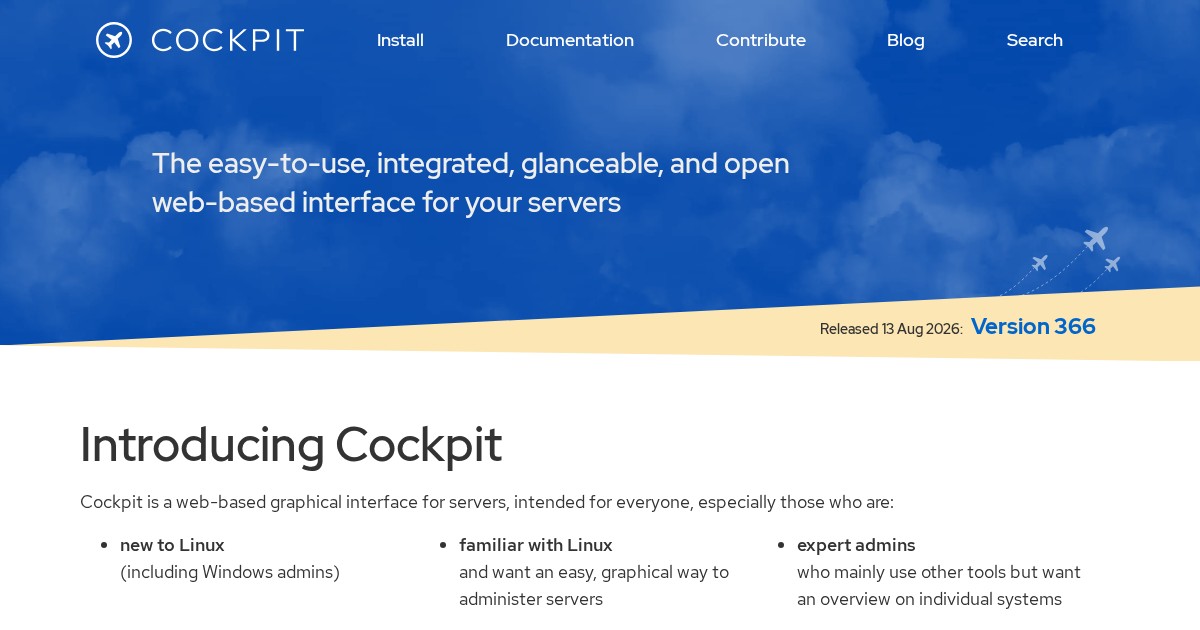
Cockpit is a web-based graphical interface for Linux servers, developed by Red Hat and included in the default repositories of most major distributions.
Why self-host Cockpit
Cockpit is unusual among admin panels: it does not replace your system’s configuration or introduce its own abstractions. It reads and writes the same systemd units, network configuration, and storage layout you would manage from a shell, so anything you do in the UI is visible and reversible from the command line. Nothing is stored in a separate database, and there is no agent to keep running: the service starts on demand when you connect.
What it does
Cockpit falls into the Server Management category of self-hosted software. It covers service management through systemd, journal log browsing, storage including LVM and RAID, network interfaces and firewall rules, user accounts, software updates, performance metrics, and an interactive terminal in the browser. Optional modules add container management via Podman, virtual machine management via libvirt, and Btrfs or ZFS tooling depending on the distribution.
Community traction
Cockpit ships as the default web console on Red Hat Enterprise Linux, Fedora, and Rocky, and is packaged for Debian, Ubuntu, and openSUSE. That distribution presence rather than raw star count is what makes it ubiquitous on enterprise Linux.
Deployment
Install from your distribution’s repository, for example with apt install cockpit or dnf install cockpit, then enable the socket. It listens on port 9090 and authenticates against local system accounts using PAM, so there are no separate credentials to manage.
Alternatives
Webmin covers more configuration surface with a much older interface. Portainer and Komodo focus specifically on containers rather than the host itself.
Maturity
Cockpit follows a rapid numbered release cadence, with version 363 released in mid-2026, and is maintained by Red Hat with long-term stability guarantees on enterprise distributions.
License
Cockpit is released under the GNU Lesser General Public License v2.1.
Links
Cockpit is the low-commitment option: install it, use it when a GUI is faster, and lose nothing when you go back to the shell.