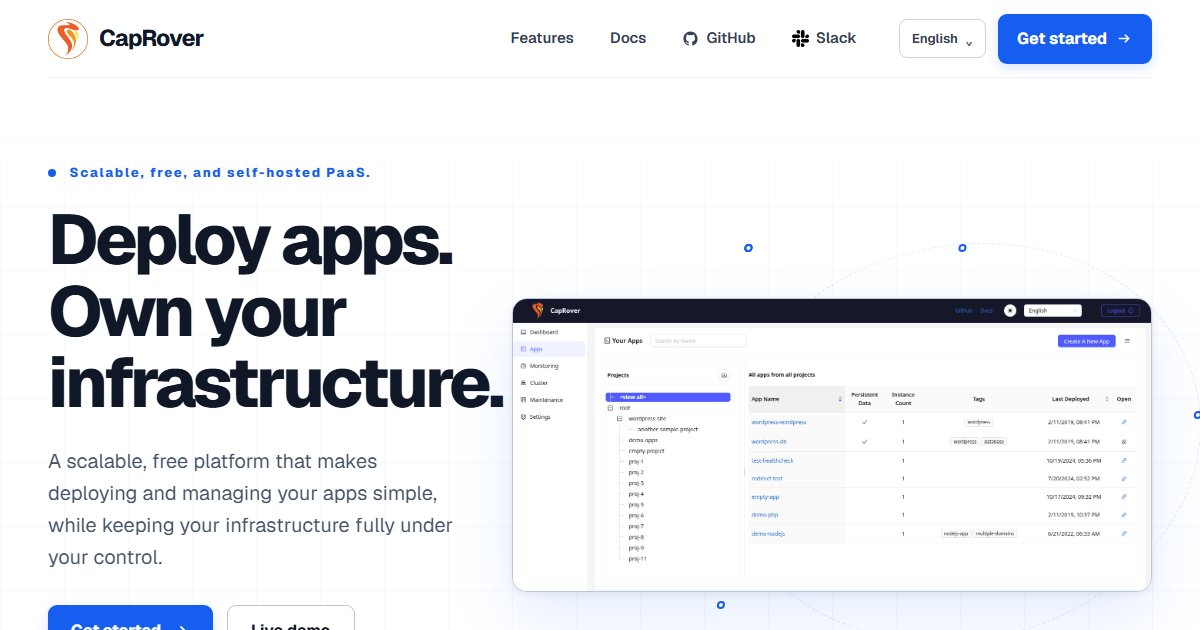
CapRover: A Self-Hosted Heroku on Docker Swarm
CapRover turns one or more servers into your own platform-as-a-service: push your code, or pick an app from a catalogue, and CapRover builds it, runs it in Docker, gives it a domain and an HTTPS certificate, and keeps it running. It is one of the longest-standing self-hosted Heroku alternatives.
Features
- One-click apps: WordPress, databases (PostgreSQL, MySQL, MariaDB, MongoDB, Redis), and hundreds of community templates
- Deploy your own apps in Node.js, Python, PHP, Ruby, Go, or anything with a Dockerfile
- Docker Swarm clustering, so adding servers adds capacity
- nginx load balancing with customisable templates
- Free TLS certificates through Let’s Encrypt
- A web dashboard and a CLI for deployments
- No lock-in: apps are ordinary Docker services and keep running if CapRover itself is removed
Deployment
CapRover installs on a fresh server with Docker, using a one-line container start documented on its site, followed by caprover serversetup from your workstation to set the root domain. Point a wildcard DNS record (for example *.apps.example.com) at the server so each app gets a subdomain automatically.
CapRover, Coolify, Dokku, or Dokploy?
| CapRover | Coolify | Dokku | Dokploy | |
|---|---|---|---|---|
| Interface | Web + CLI | Web | CLI (git push) | Web |
| Multi-server | Docker Swarm | SSH to servers | Single host | Swarm |
| One-click apps | Large catalogue | Large catalogue | Plugins | Templates |
| Style | Mature, stable | Fast-moving | Minimal, scriptable | Newer |
CapRover’s strength is maturity and a simple mental model. Coolify has more momentum and a more modern interface; Dokku suits people who want git push and nothing else.
License
Apache License 2.0.