Linux 7.3 Released With 18,765 Commits From a Record 807 First-Time Developers
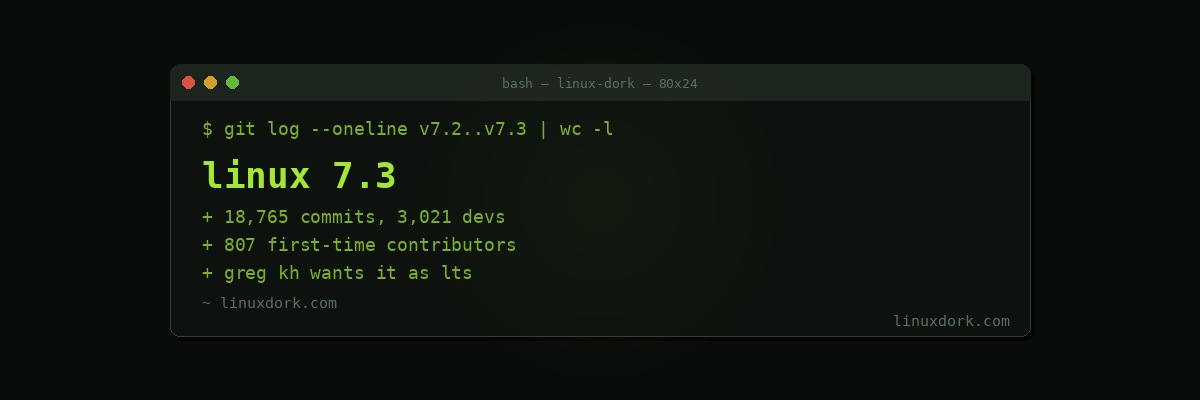
Linus Torvalds released Linux 7.3 on October 18, closing a cycle that produced 18,765 non-merge commits from 3,021 developers. Of those developers, 807 were contributing to the kernel for the first time, which is a high figure even by recent standards.
The release followed the usual weekly candidates, with 7.3-rc4 and 7.3-rc5 both arriving quietly enough that Torvalds described the tail of the cycle as uneventful.
What landed
The headline items were spread across hardware support and filesystems rather than concentrated in one subsystem.
- Steam Controller support gained a proper in-tree driver, covered in our earlier report
- The xpad driver picked up Azeron and Victrix controllers, per our controller roundup
- Btrfs took a batch of fixes during the candidates, including the ones we wrote up at rc4
- x86 saw a round of corrections late in the cycle
The silent data loss bug involving MADV_FREE and transparent huge pages, which we covered in September, was resolved before release.
The AI patch question
This cycle was the one where machine-generated patches became a visible part of the workflow rather than a curiosity. We covered the merge window flood at the time, and the related decision to drop the Assisted-by tag from Torvalds’ own commits.
The volume of first-time contributors is worth reading alongside that. Some of it reflects genuine new participation, and some reflects tooling that makes a first patch easier to produce than it used to be. The kernel’s own position on how such contributions should be labelled is still settling, and Mesa has since taken a different approach.
LTS status
On November 2, Greg Kroah-Hartman told the Linux Kernel Mailing List that he plans for 7.3 to become the next long-term support branch, rather than the upcoming 7.4.
That had not been reflected on kernel.org’s release page as of late November, and some coverage has assumed 7.4 would take the role instead, so treat it as the maintainer’s stated intent rather than a published designation. Our LTS versus rolling release guide covers why the choice matters for anyone pinning a kernel.
Point releases
Stable updates have followed at the usual pace. 7.3.5 arrived on November 17 alongside 6.18.64 and 6.12.118, and 7.3.6 appeared the following week.
If you are tracking a stable series rather than building your own, our keeping Linux updated guide covers the mechanics, and Ubuntu 26.10 ships 7.3 already.
Attention has moved on to 7.4, whose merge window set a record.