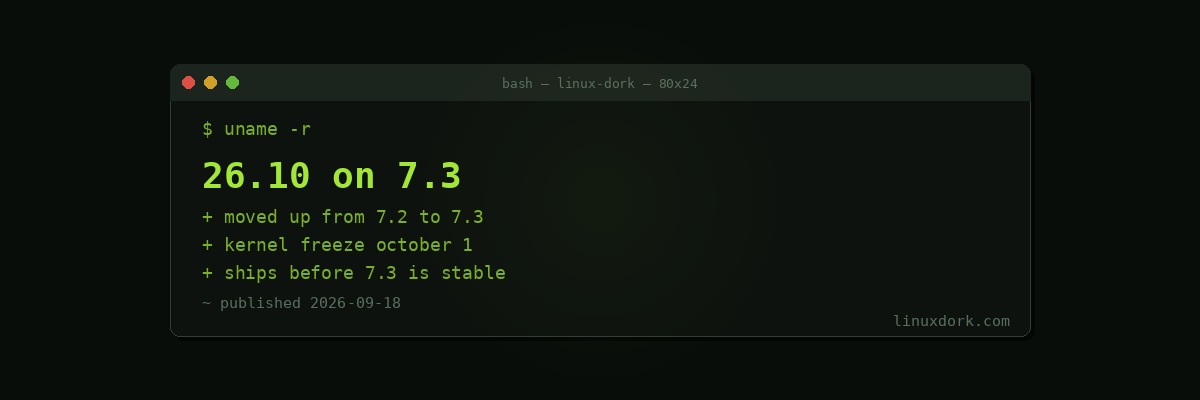
Ubuntu 26.10 Moves Up to Linux 7.3, and Will Ship Before the Kernel Is Finished
Ubuntu 26.10 “Stonking Stingray” will ship with Linux 7.3 rather than the 7.2 Canonical announced back in May.
The reason is a compliment to upstream. From the Canonical kernel team:
“Thanks to the upstream Linux development schedule, which faced no delays during the 7.1 and 7.2 release cycles and has already seen the release of 7.3-rc1, we are excited to share that we are stepping up our target: Ubuntu 26.10 will now target the Linux 7.3 kernel instead of 7.2.
This update keeps us aligned with the latest upstream capabilities, particularly for the latest hardware support, while remaining on track for our upcoming release milestones.”
Two consecutive kernel cycles landing on schedule was enough to make the team comfortable reaching one release further forward.
The dates do not quite line up
This is the part worth understanding before you install:
| Milestone | Date |
|---|---|
| Ubuntu 26.10 kernel freeze | 1 October |
| Ubuntu 26.10 release | 15 October |
| Linux 7.3 stable, if on time | 18 October |
| Linux 7.3 stable, if one more rc is needed | 25 October |
Ubuntu 26.10 ships before Linux 7.3 exists as a stable release. The ISOs will carry a pre-release 7.3 kernel, with the finished version arriving afterwards through stable release updates.
That is less alarming than it sounds and is not nothing either. By kernel freeze on October 1, 7.3 will be at roughly rc6 or rc7, which is deep enough into the cycle that remaining changes are small fixes rather than features. rc4 landed on September 20 and Torvalds described it as large but unworrying.
The honest framing: you get newer hardware support several weeks earlier, and you carry a kernel that upstream has not yet declared finished until the first SRU arrives.
Why Canonical is willing
26.10 is not an LTS. Interim releases get nine months of support and exist partly to move fast and find problems before the next LTS inherits the result.
This is the right release to be aggressive in. The same decision on 26.04 LTS, which organisations deploy for five years, would be indefensible. Our Ubuntu 26.04 LTS coverage shows the contrasting posture.
The pattern is deliberate: interim releases take the risk, the LTS takes what survived.
What 7.3 brings
Worth noting given how filesystem-heavy this cycle has been, including a Btrfs regression fix that only landed at rc4. Anyone upgrading a Btrfs root to 26.10 wants the SRU kernel rather than the ISO one.
26.10 also completes the Rust coreutils transition, so this release changes both the kernel and the userland underneath it at once.
# after upgrading
uname -r
apt policy linux-generic

# keep the kernel current through SRUs
sudo apt update && sudo apt full-upgrade
If you run servers
Interim Ubuntu releases are not what you want under production workloads, and an interim release carrying a pre-release kernel is further still from it. Stay on 26.04 LTS, which our hosting guides assume for good reason.
For a desktop or a laptop with hardware new enough to need current drivers, 26.10 on 7.3 is a reasonable trade, provided you let the first round of stable updates land before you rely on it.