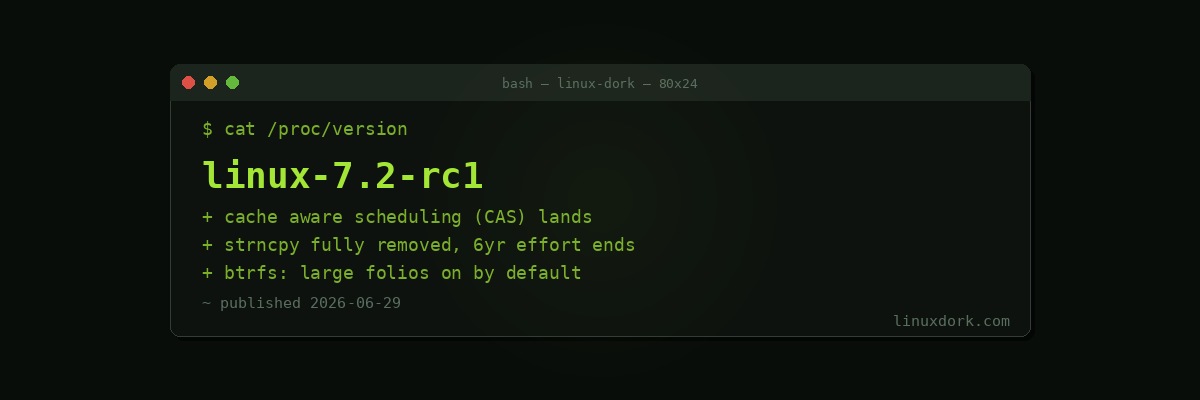
Linux 7.2-rc1 Lands: Cache Aware Scheduling, the End of strncpy, and Btrfs Large Folios
Linus Torvalds tagged Linux 7.2-rc1 on June 28, 2026, two weeks after 7.1 shipped, closing the merge window for the next cycle. The kernel source tree has now passed 43 million lines. Final release is expected in the second half of August, timing dependent on how many release candidates the cycle needs.
Cache Aware Scheduling
The most consequential change merged this cycle is Cache Aware Scheduling (CAS), an addition to the CPU scheduler that tracks which CPU cache a task’s working set was last resident in and biases future placement decisions toward keeping it there. On multi-core and multi-socket systems, moving a task to a different core often means reloading its working set into a cold cache, which costs real cycles. CAS aims to reduce that churn, and early benefit is expected to be most visible on larger multi-core desktops and servers rather than single-socket laptops.
strncpy Is Finally Gone
Linux 7.2 completes a six-year effort to remove every use of the deprecated strncpy() API from the kernel tree, replacing it with safer, more explicit string-handling functions like strscpy(). strncpy() has a well-known footgun: it does not guarantee null-termination and silently zero-pads the remaining buffer, which has been a recurring source of subtle kernel bugs. This is a maintenance and hardening change rather than a user-facing feature, but it closes out a long-running cleanup effort.
Btrfs Large Folios by Default
Btrfs now enables large folios by default. Folios are the kernel’s replacement for individual memory pages as the basic unit of page cache management, allowing the kernel to track larger contiguous chunks of memory as a single unit instead of many small pages. For Btrfs specifically, this reduces per-page bookkeeping overhead on large file operations, which should help throughput on workloads that move large files around, such as backups and media libraries.
GPU and Driver Additions
- AMD ISP4 driver: initial support for AMD’s newer image signal processor hardware, mainly relevant to laptops with AMD’s integrated camera pipeline
- AMDGPU HDMI 2.1 FRL: initial Fixed Rate Link support, a prerequisite for higher-bandwidth HDMI 2.1 display modes
- Intel Xe driver: initial support for CRI platforms and Panther Lake R-series CPU model numbers
- USB4STREAM: an Intel-led feature for streaming media over USB4 links
Rust Zerocopy and ARM64 Additions
The in-tree Rust support gains bindings for the zerocopy crate, intended to make zero-cost memory reinterpretation easier to use safely from Rust kernel code as more subsystems adopt Rust alongside C. Separately, AArch64 picks up new hardware capability flags for the 2025 dpISA extensions, letting userspace detect and use newer ARM instruction set additions.
What to Expect Before Final
With the merge window closed, the remaining rc cycles are for stabilization: regression fixes, driver bugs, and NTFS3 hardening following its 7.1 debut. If you track kernel development closely, linux-next and the weekly rc tags are the place to watch; Arch and Gentoo testing repositories typically carry rc kernels within a few days of each tag.