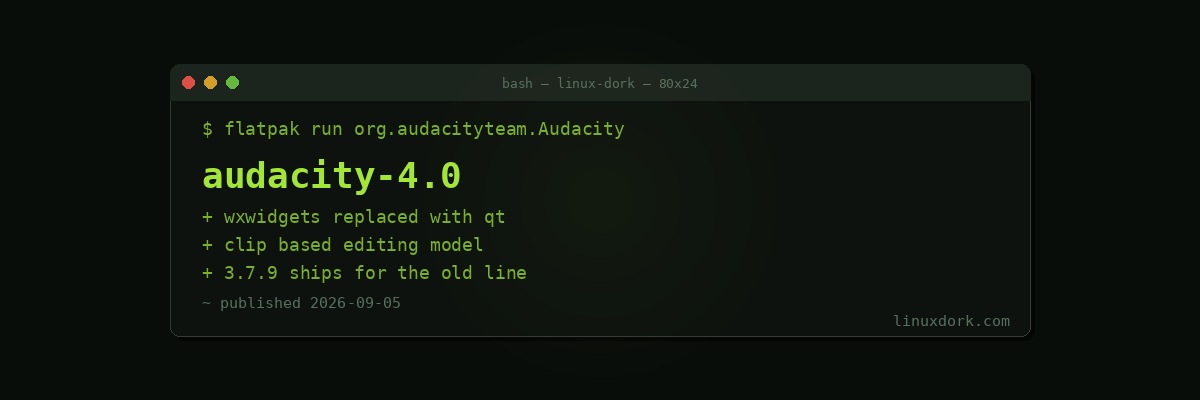
Audacity 4.0 Lands with a Rebuilt Qt Interface and a New Editing Model
Audacity 4.0 is out with a redesigned Qt interface and a new editing model. For an application that has looked and behaved much the same since the early 2000s, this is a genuine break.
What changed
The toolkit. Audacity has used wxWidgets for its entire life. 4.0 moves to Qt, which is why the interface looks different rather than merely rearranged. Qt gives better high-DPI handling, better platform integration, and a considerably more capable widget set, and it aligns Audacity with MuseScore, the other application under Muse Group.
The editing model. This is the substantive change. Audacity’s traditional model is destructive editing on a timeline: you select a region, apply an effect, and the samples change. The new model moves toward something closer to what modern DAWs do, with clips as manipulable objects.
For anyone who has used Ardour, Reaper, or Audition, that is the expected way to work. For someone who has used Audacity for fifteen years, it means the muscle memory no longer applies.
The risk
Audacity’s user base is unusual. It is enormous, it is largely non-professional, and it overwhelmingly consists of people doing a specific small task: trimming a podcast, cleaning up a voice recording, converting a file, removing hiss from a transfer. They chose Audacity because it did that one thing without requiring them to learn a DAW.
Rebuilding the interface and the editing model for that audience is a real gamble. The counter-argument, which is also fair, is that the old interface was genuinely showing its age, high-DPI support was poor, and continuing to maintain a wxWidgets application in 2026 has its own costs.
There is also the 3.7.9 release shipping alongside, which adds FFmpeg 9 support and fixes data loss issues. The existence of a parallel 3.x release suggests the project expects people to stay on the old line for a while, which is sensible.
The Muse Group context
Audacity was acquired by Muse Group in 2021, and the aftermath was messy: a telemetry proposal that was withdrawn after significant backlash, a privacy policy rewrite that caused further alarm, and a fork, Tenacity, created by people who did not want to wait and see.
Muse Group has since behaved considerably better than that start suggested, and the investment is visible in this release. It is still reasonable for people to watch a corporate steward of a GPL application with some attention, and Tenacity exists for anyone who would rather not.
Practical advice
Do not upgrade mid-project. If you have work in progress, finish it on 3.x.
Flatpak and AppImage make this easy to test. Install 4.0 alongside your existing version rather than replacing it, decide whether the new model suits you, and keep whichever wins.
flatpak install flathub org.audacityteam.AudacityCheck your effects and plugins. A toolkit change and an editing model change together mean LADSPA, LV2, and VST plugin behaviour is worth verifying before you rely on it.
If Audacity is a tool you use occasionally for simple edits, there is no urgency. If it is part of a workflow you depend on, test it properly before committing.