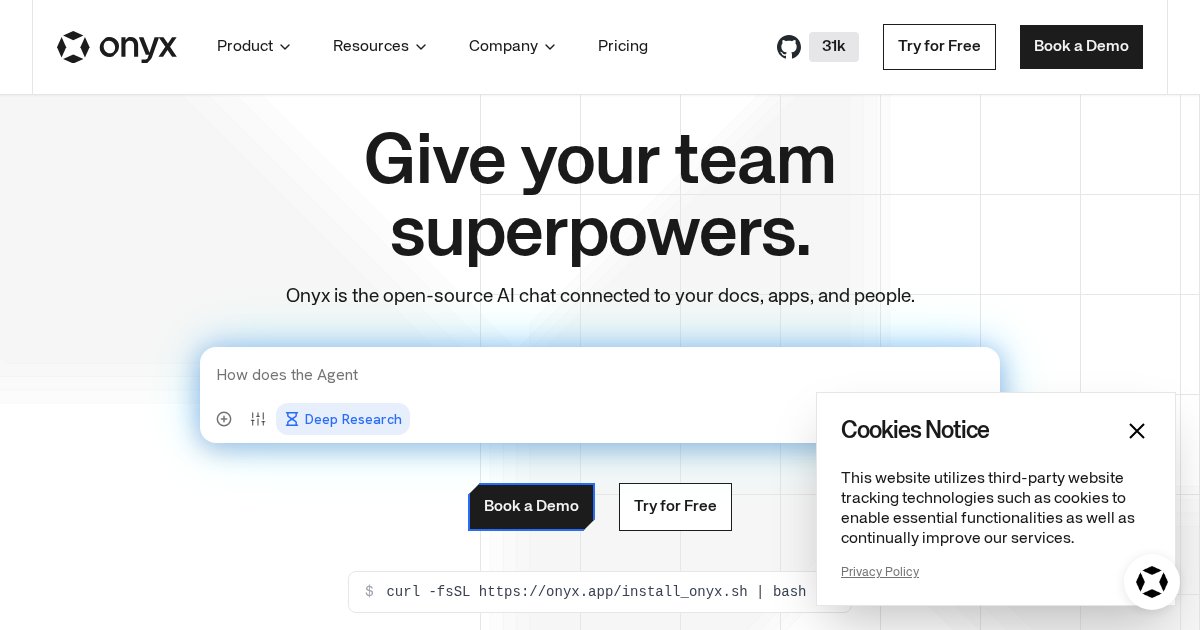
Onyx: Search and Chat Across Your Team's Tools
Onyx, previously named Danswer, indexes the systems a team actually stores knowledge in and provides one search and chat interface over all of them.
The problem it addresses
Organisational knowledge scatters. The answer is in a Slack thread from March, a Confluence page nobody links to, a Google Doc, a GitHub issue, or a PDF in shared storage. Finding it requires knowing which system it is in, which is the thing you do not know.
Onyx connects to those systems, indexes their contents, and answers questions with citations pointing back at the source.
Connectors
Dozens, covering Slack, Confluence, Jira, Google Drive, Notion, GitHub, GitLab, SharePoint, Zendesk, and more, plus generic web crawling and file upload.
Connectors sync on a schedule and handle incremental updates, so the index reflects reality rather than the day you set it up.
Permissions
The feature that separates this from a general RAG tool. Onyx can respect source permissions, so a user only gets answers from documents they were already allowed to see.
Without that, an internal search tool becomes a data leak: someone asks a question and gets an answer sourced from a document they had no access to. Any serious deployment needs this.
Models
Works with hosted providers and with local models through Ollama or vLLM. For an organisation that cannot send internal documents to a third party, local inference is what makes the whole thing possible.
Running it
Docker Compose with PostgreSQL and a vector database. It is a substantial stack aimed at teams rather than individuals, and it wants real resources.
Where it fits
Onyx for a team, with many source systems and permission requirements.
AnythingLLM for a defined document set you upload yourself.
Khoj for personal notes and files.
License
Onyx is released under the MIT License, with some enterprise features under a separate licence.