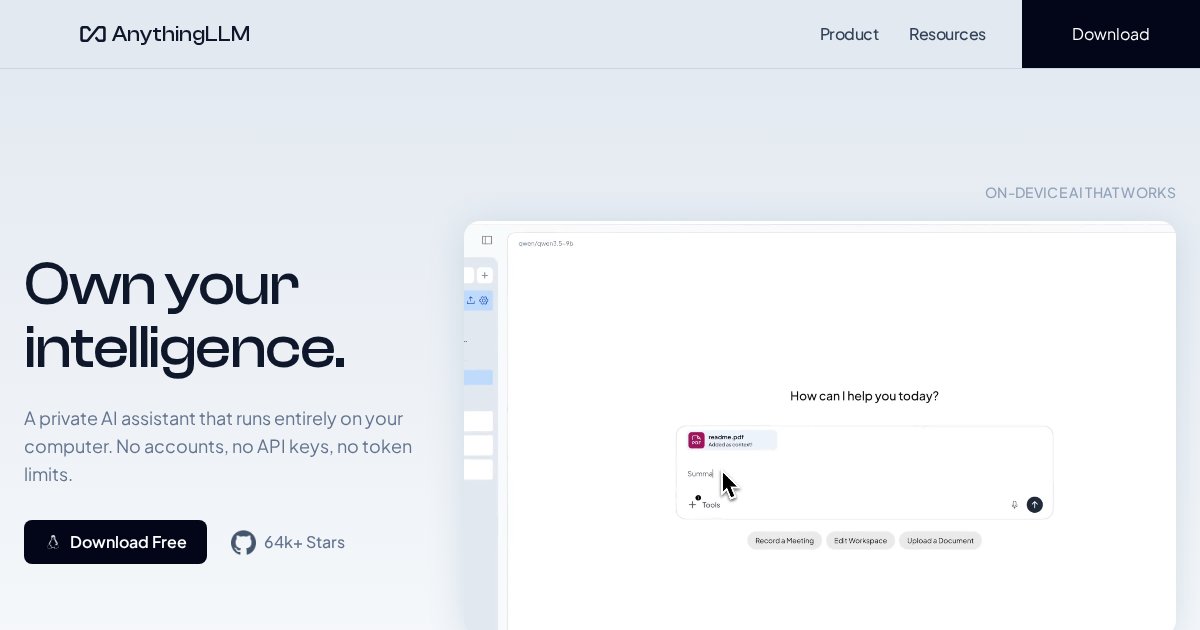
AnythingLLM: Chat With Your Own Documents
AnythingLLM turns a pile of documents into something you can ask questions of. It handles the whole retrieval-augmented generation pipeline: ingesting files, chunking them, generating embeddings, storing them, and assembling context for the model.
What RAG actually solves
A language model knows what it was trained on. It does not know your contracts, your documentation, or the PDF a client sent last week.
RAG closes that gap without retraining anything. Your question is embedded, semantically similar chunks of your documents are retrieved, and those chunks are handed to the model along with the question. The model answers using material it has just been shown.
The practical benefit is citations. AnythingLLM shows which documents an answer drew from, which is the difference between a tool you can check and one you have to trust.
Workspaces
Documents are organised into workspaces, and each workspace has its own document set, conversation history, and settings.
This matters more than it sounds. A single undifferentiated pile of documents produces poor retrieval, because the semantically nearest chunk to your question may come from an unrelated project. Separate workspaces keep the search space relevant.
It brings its own everything
The appeal is that you do not have to assemble a stack. AnythingLLM bundles the vector database, the embedding model, and the document processing, and works out of the box with a local model through Ollama or LocalAI, or with a hosted API.
That is the tradeoff against something like Dify or RAGFlow, which give you more control over each stage and require you to care about each stage.
Practical notes
Ingestion quality determines answer quality. Clean text extracts well; scanned PDFs without OCR extract badly and produce confident nonsense.
It ships as a desktop application and as a Docker container. The container version supports multiple users and is the one to run on a server.
License
AnythingLLM is released under the MIT License.