Mimir: Horizontally Scalable Prometheus Storage
Mimir is centralised metrics storage that speaks Prometheus, intended to be the destination rather than an addition.
The architectural difference from Thanos
Both solve long retention and global query for Prometheus metrics. The shapes differ.
Thanos attaches a sidecar to Prometheus servers you already run and federates across them.
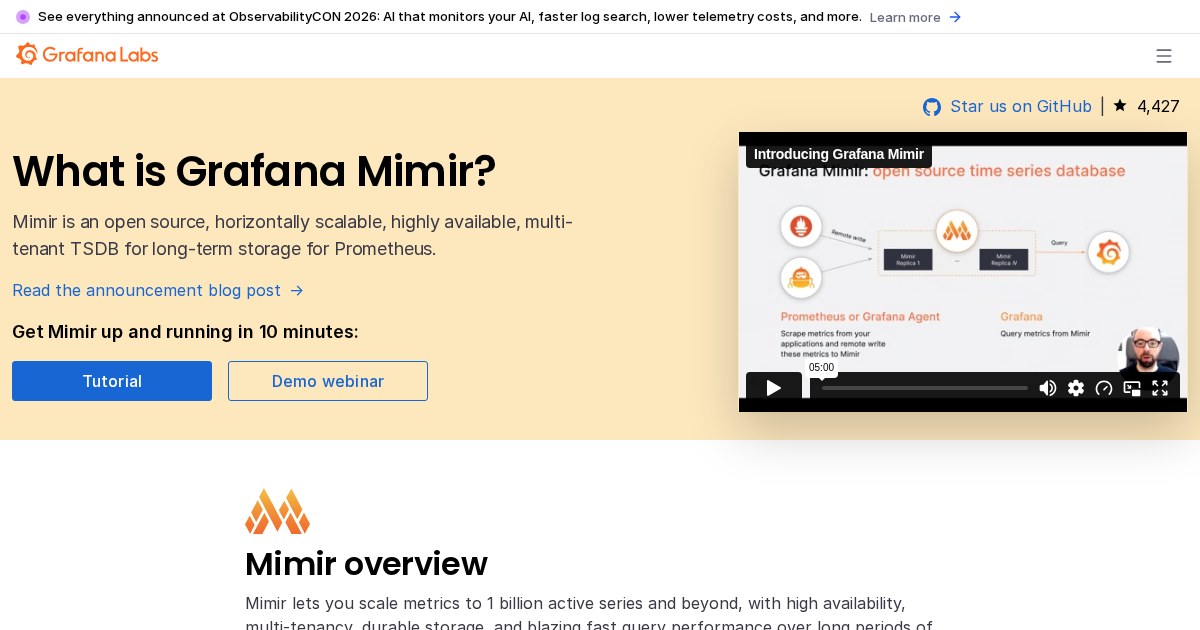
Mimir receives metrics by remote write and stores them centrally. Your Prometheus servers become collectors that forward and forget, or you drop them for Grafana Alloy.
That makes Mimir cleaner when you are designing the system, and a bigger change when you already have Prometheus servers holding data you care about.
Multi-tenancy is first class
Metrics are partitioned by tenant with per-tenant limits and retention. For an internal platform serving several teams, that is the feature: one deployment, isolated data, enforced quotas.
Thanos can be made multi-tenant with effort. Mimir assumes it.
Monolithic or microservices
Mimir runs as a single binary in monolithic mode, which is genuinely usable for a modest deployment, or split into ingesters, distributors, queriers, compactors and store gateways for scale.
Starting monolithic and splitting later is the sensible path, and it is a real advantage over architectures that demand the full topology on day one.
Storage
S3-compatible object storage, so MinIO, Garage or SeaweedFS for self-hosting.
Querying
The Prometheus HTTP API, so Grafana and anything else speaking PromQL works unchanged. Our Prometheus alerting guide covers rules, which Mimir can evaluate centrally via its ruler.
Operational caution
Ingesters hold recent data in memory and on local disk before flushing. Losing an ingester before a flush loses that window unless replication is configured, so the replication factor is not an optional tuning knob.
Cardinality is the usual way these systems fall over: a label with unbounded values multiplies series until memory runs out. Set per-tenant series limits before you need them, and our memory pressure guide covers what the failure looks like.
License
Mimir is released under the GNU Affero General Public License v3.