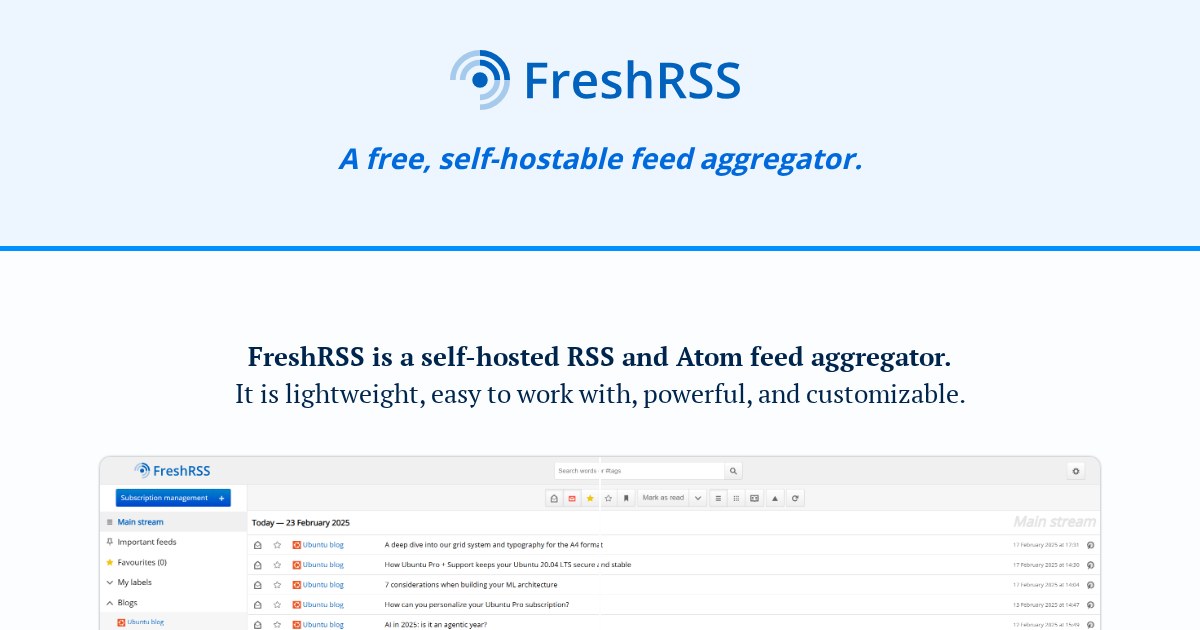
FreshRSS: Self-Hosted RSS Aggregator
FreshRSS collects your feeds server-side, so read state and subscriptions stay consistent across every device you read on.
Why server-side aggregation matters
A desktop RSS reader keeps its state locally, which falls apart the moment you read on a phone as well. FreshRSS polls feeds on a schedule and holds the canonical read state, so any client showing you the list agrees with every other one.
Client compatibility is its strongest feature
FreshRSS implements the Google Reader API and the Fever API, which means most third-party RSS clients work with it directly: FeedMe, Reeder, NetNewsWire, Read You, and many others. You are not locked into an official app, and switching clients later costs nothing.
Features worth knowing
Filters and user queries for automatically labelling or hiding articles, extensions for things like fetching full article text when a feed only publishes summaries, multi-user support with separate subscriptions, and a web reader that is genuinely pleasant to use directly.
Resource use
It is PHP with MySQL, PostgreSQL, or SQLite, and it is light: a Raspberry Pi handles hundreds of feeds without difficulty. Feed polling frequency is the main tunable, and being polite to publishers by not polling every minute is worth configuring deliberately.
Alternatives
Miniflux is a minimalist Go alternative with a deliberately spare interface and very low resource use. Tiny Tiny RSS is the long-established option with more configuration and a more dated feel.
License
FreshRSS is released under the GNU Affero General Public License v3.0.