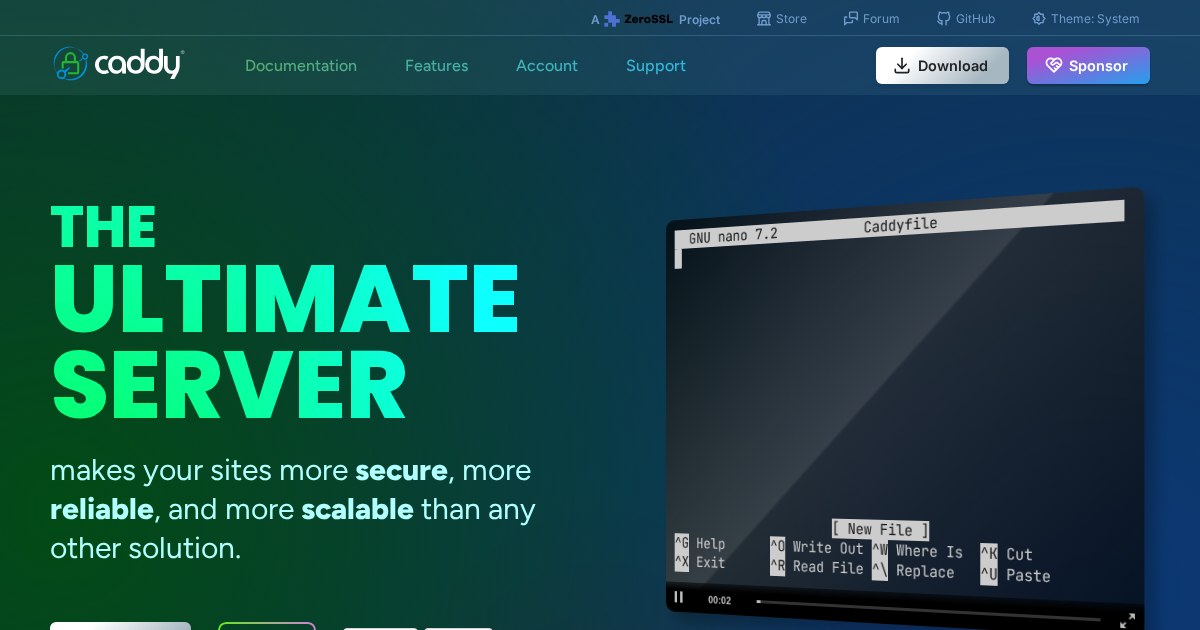
Caddy: Web Server With Automatic HTTPS
Caddy is a web server whose defining feature is that HTTPS simply works: it obtains, installs, and renews certificates from Let’s Encrypt without being asked.
The configuration difference
A working reverse proxy with valid TLS in Caddy looks like this:
app.example.com {
    reverse_proxy 127.0.0.1:8096
}
That is the complete configuration. The equivalent nginx block runs to fifteen lines plus a separate certbot setup and a renewal cron job. For a homelab where the requirement is routing a handful of hostnames to a handful of ports over HTTPS, this is the least configuration that can possibly work.
What else it does
Static file serving, HTTP/2 and HTTP/3, on-demand TLS for dynamic hostnames, and a plugin ecosystem covering DNS providers for wildcard certificates, authentication, and rate limiting. Configuration can also be driven through a JSON API for programmatic setups.
Where the alternatives win
Traefik discovers containers automatically from labels, which Caddy does not do natively. Nginx Proxy Manager provides a web UI for people who would rather click than edit a file. Plain nginx has deeper tuning options and a larger body of existing documentation for exotic requirements.
Our reverse proxy guide compares the three approaches in more detail.
Practical note
Automatic certificates require ports 80 and 443 reachable and a resolving DNS record, or a DNS provider plugin for the DNS challenge. That plugin route is what you want for internal-only services that should still have valid certificates.
License
Caddy is released under the Apache License 2.0.