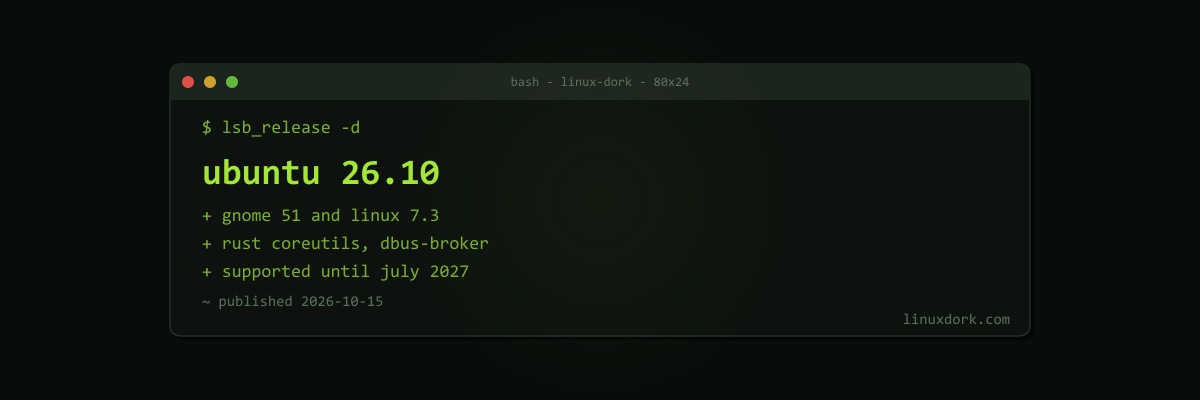
Ubuntu 26.10 "Stonking Stingray" Released With GNOME 51, Linux 7.3, and dbus-broker
Ubuntu 26.10 “Stonking Stingray” was released on October 15. It is an interim release with nine months of support, until July 2027, and the first step toward Ubuntu 28.04 LTS. If you want long-term stability, Ubuntu 26.04 LTS remains the release to run.
Desktop and kernel
- GNOME 51, with better window snapping, monitor brightness that persists across reboots, automatic screen rotation on supported devices, and an option to disable the touchpad while a mouse is connected
- The App Center gets one details page for Snap and DEB packages, plus a section for choosing graphics drivers, including NVIDIA driver versions
- Linux 7.3. The shipped kernel, 7.3.0-9.9, is based on 7.3-rc6, because the final upstream 7.3 lands after Ubuntu’s release date; the stable version arrives as an update
- Mesa 26.2 and improved support for Snapdragon X Elite and X2 Elite laptops
Plumbing changes
Rust coreutils, completed. Ubuntu 26.04 moved most coreutils to the Rust-based uutils; 26.10 switches the rest, including cp, mv, and rm. Our Rust coreutils explainer covers what changes in practice.
dbus-broker replaces dbus-daemon for both the system and session buses, and systemd 261 drops support for legacy System V init scripts. If you still rely on an old /etc/init.d script, now is the time to write a proper service file.
OpenSSL 4 is the system TLS library, and Sequoia PGP (sq, sqv) joins the main archive alongside GnuPG.
Encryption and boot
TPM-backed full disk encryption can now be installed on machines without a hardware root of trust, provided you set a PIN or passphrase. Two caveats from the release notes: systems using TPM-backed FDE cannot upgrade from 26.04 to 26.10 at release, and running update-grub after manual GRUB customisations can leave a TPM/FDE system unbootable while a fix is prepared. Our TPM unlock guide explains how the pieces fit.
RISC-V
Ubuntu Desktop now has official RISC-V images for SpacemiT K3 boards and QEMU, though GPU and video acceleration are not yet working on K3.
Toolchains
GCC 15.2, LLVM 22, Python 3.14.7, Rust 1.97.1, Go 1.27, OpenJDK 25 (with OpenJDK 27 packaged), .NET 10, and Zig 0.16.
Getting it
ISOs are on our Ubuntu 26.10 download page. Upgrades from 26.04 LTS are possible, but read the known issues first; a dangling /lib32 symlink can stop the upgrade, and the upgrader fix is still in progress.