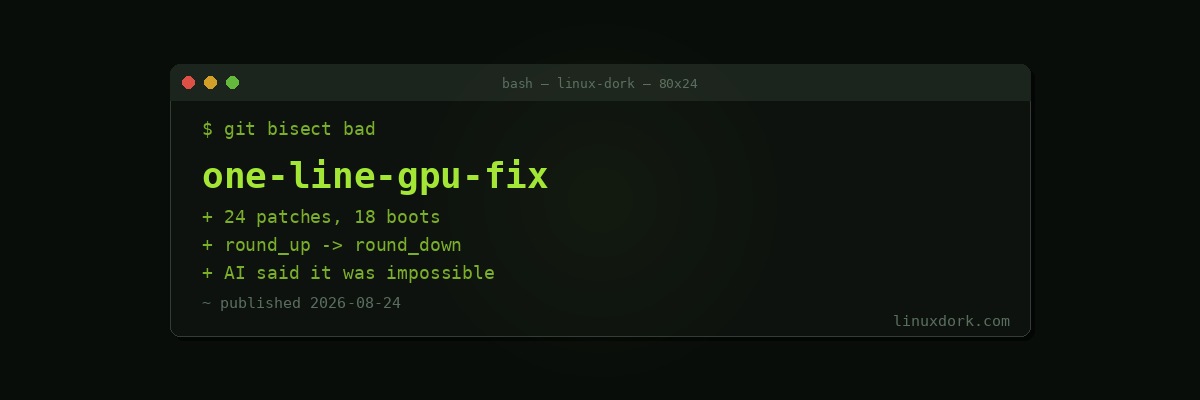
Torvalds Spent 24 Debug Patches and 18 Boots on a One-Line GPU Bug, and Says AI 'Enormously Helped'
Linus Torvalds merged a one-line fix on August 21 for an Intel Xe GPU bug that had been sitting in a two-year-old commit, corrupting page tables and blacking out displays on Battlemage G21 hardware.
Getting to that one line took 24 debug patches and 18 kernel boots. He described the process as a debug session from hell, and said an AI tool “enormously helped.”
The bug
The fault was a VRAM offset calculation error in get_flat_ccs_offset(). The fix was changing a round_up() to a round_down().
This is the classic shape of a genuinely hard kernel bug. The symptom is catastrophic and remote from the cause, the faulty code has been in the tree for two years without anyone noticing, and the fix is small enough to look obvious once you have it. Nothing about a one-character-class change tells you it took 18 reboots to find.
What the AI actually did
Torvalds used Gemini as what he called a tireless helper through the debugging process. The notable part is that the AI repeatedly insisted the bug was impossible and unsolvable.
That is worth sitting with, because it is a more honest account of AI-assisted debugging than most. The tool was not right. It did not identify the bug. It was wrong in a confident and persistent way about whether the bug could even exist.
It was still useful, because the value in a session like this is not a correct answer handed to you. It is having something that will read the same code for the twentieth time without getting tired, propose the next thing to instrument, and hold context across 18 boot cycles while you slowly eliminate possibilities. Torvalds also let it draft the commit message, which is a small gesture from someone historically protective of the kernel’s communication standards.
The counterpoint to last week
This lands in an interesting spot. Days earlier, the kernel’s networking maintainers described themselves as “completely overwhelmed” by the volume of LLM-generated patches during the 7.3 merge window. OpenSSH announced it would ship security releases more often because AI-assisted vulnerability reports were outpacing its schedule. Debian is voting on whether to permit LLM-assisted contributions at all.
Torvalds using AI productively is not a contradiction of any of that. It is the distinction that the whole argument keeps failing to make.
An expert using a tool to accelerate their own reasoning on a problem they deeply understand is a completely different activity from an unlimited number of people generating patches for maintainers to review. The first produces one correct one-line fix. The second produces review load. The tool is the same; the effect on a project depends entirely on who is holding it and whether they can evaluate the output.
That is not a comfortable position for anyone wanting a simple rule, which is roughly why Debian’s ballot ended up with eight options on it.
Where the fix lands
The fix will appear in Linux 7.3 and in stable backports. If you have a Battlemage G21 card and have been fighting black screens, this is the one.