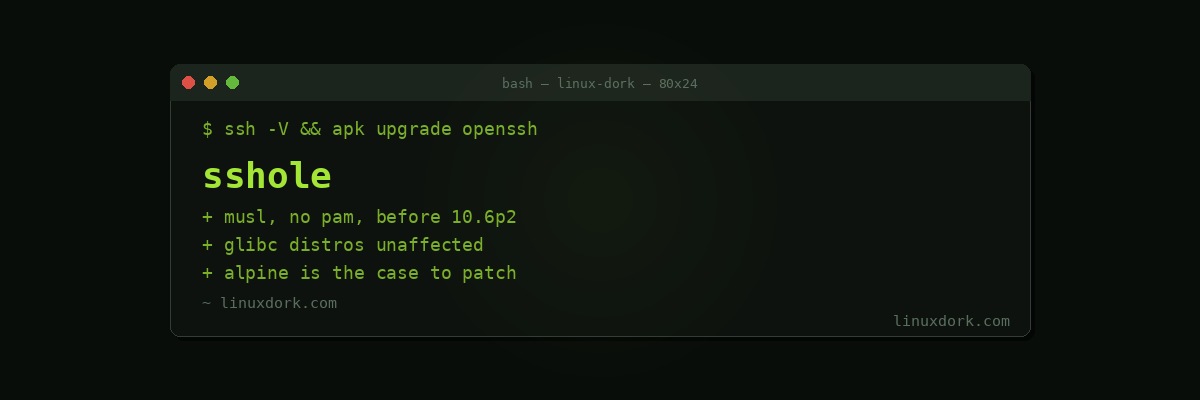
OpenSSH "sshole" Authentication Bypass Hits musl Systems Without PAM
OpenSSH 10.6p2 was released on November 5 to fix CVE-2026-123158, an authentication bypass nicknamed “sshole”. It carries a CVSS score of 8.1, and it is being actively exploited.
Who is affected
This is narrower than the severity suggests, and the conditions are specific. A system is affected when all of the following hold:
- It runs OpenSSH before 10.6p2
- It is a Linux system built against the musl C library
- It does not check passwords through PAM
Alpine Linux is the headline case, since musl is its defining characteristic and PAM is not in the default configuration. Containers built FROM alpine with an sshd inside them are the population to worry about.
Not affected:
- glibc-based distributions, which is nearly every general-purpose Linux: Debian, Ubuntu, Fedora, RHEL, Arch, openSUSE
- Any system where sshd authenticates passwords through PAM, regardless of libc
- Non-Linux systems, including OpenBSD
- Dropbear
If you are running Debian or Fedora on your servers, this one is not yours. If you have Alpine containers exposing ssh, it is.
What to do
# version check
ssh -V
sshd -V 2>/dev/null

# on Alpine
apk update && apk upgrade openssh
apk info -v openssh

# confirm you are past the fix
ssh -V | grep -o 'OpenSSH_[0-9.]*p[0-9]*'
Patch first. Then, if patching is delayed for any reason, the mitigation follows directly from the preconditions: password authentication is what is bypassed, so turning it off removes the exposure.
# /etc/ssh/sshd_config
PasswordAuthentication no
KbdInteractiveAuthentication no
PubkeyAuthentication yes
PermitRootLogin prohibit-password
# validate before restarting, always
sudo sshd -t
sudo rc-service sshd restart # Alpinesshd -t before the restart. A config error plus a restart on a remote machine is how people lock themselves out, and our ssh hardening guide covers testing in a second session before closing the first.
Key-only authentication is the right configuration regardless of this flaw, per our ssh keys guide. An installation already following that advice was never exposed to this.
Why the libc matters
The interesting part of this bug is that the vulnerable condition is a combination rather than a single defect.
Password checking without PAM goes through the traditional getpwnam and crypt path. The behaviour of that path differs between glibc and musl in ways that are individually defensible and that interact badly here. Our nsswitch guide covers the identity side and PAM guide covers the authentication side, and the distinction between those two is exactly what this bug sits in.
It is also a reminder that musl is not a drop-in equivalent to glibc for security-sensitive code. Alpine’s small images are genuinely useful, and the libc difference is a real difference. That is worth holding in mind as musl appears in more places than it used to, systemd’s experimental support for it included.
Container audit
The practical risk here is forgotten Alpine images.
# which running containers are Alpine-based
podman ps --format '{{.Image}}' | sort -u
docker ps --format '{{.Image}}' | sort -u

# does a given image contain sshd at all
podman run --rm --entrypoint sh myimage:tag -c 'command -v sshd; ssh -V' 2>&1

# rebuild on a current base rather than patching in place
podman pull alpine:latest
podman build --pull --no-cache -t myimage:fixed .
Rebuild rather than patch the running container. Our supply chain guide covers why an image built months ago is full of known issues regardless of this CVE, and why scheduled rebuilds matter as much as scanning does.
Most Alpine containers have no business running sshd in the first place. If one does, that is worth revisiting alongside the patch.