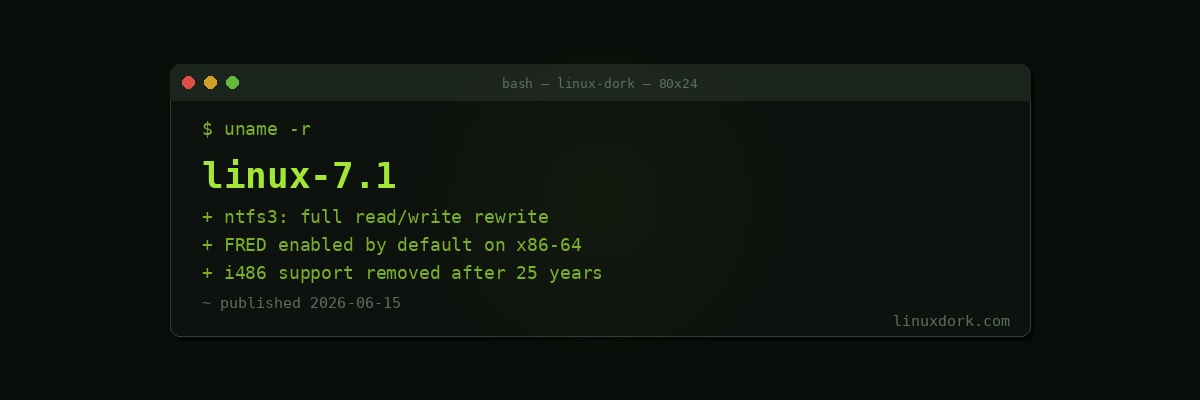
Linux 7.1 Is Out: New NTFS Driver, FRED by Default, and the i486 Era Ends
Linus Torvalds tagged the final Linux 7.1 release on June 14, 2026, roughly seven weeks after rc1 opened the merge window. The cycle ran to rc7, one release candidate longer than average, largely to give the new NTFS driver and a mid-cycle security fix extra soak time before going stable.
NTFS3 Is Now the Real Driver
The headline change is the same one previewed at rc1: a ground-up NTFS driver rewrite, four years in development, with full read/write support built on delayed allocation, iomap, and folio integration. The old read-only ntfs module built into the kernel since 2001 is now formally deprecated in favor of ntfs3.
For anyone dual-booting or mounting external Windows drives, this removes the need for the userspace ntfs-3g FUSE driver in most cases:
mount -t ntfs3 /dev/sdXY /mnt/windowsDistributions are expected to switch their udev rules to default to ntfs3 over the next one or two release cycles rather than all at once, since some enterprise deployments still depend on ntfs-3g compatibility quirks.
FRED Enabled by Default
Intel’s FRED (Flexible Return and Event Delivery) mechanism, which simplifies how the kernel receives interrupts, exceptions, and syscalls, is now on by default on supported x86-64 hardware, roughly Intel chips from 2023 onward. Machines without FRED support fall back automatically to the legacy delivery path, so there is no compatibility cliff for older hardware. The practical benefit shows up mostly in interrupt-heavy workloads such as busy network servers.
The i486 Finally Leaves the Kernel
Linux 7.1 removes support for Intel’s 486-class processors, hardware that shipped starting in 1989. The 486 lacked several instructions that later kernel code assumed were present, which meant maintaining special-case workarounds for a CPU family with no remaining commercial use. Torvalds and x86 maintainers had floated the removal for several cycles before it landed here; embedded designs that might once have used 486-class cores moved to ARM or RISC-V long ago.
DirtyClone Fix Included
Linux 7.1 also carries the fix for CVE-2026-43503, a local privilege escalation nicknamed DirtyClone that was patched during the rc5 stage in May. Anyone still running a pre-rc5 build of 7.1, or an older stable kernel without the backport, should prioritize updating. Distribution security teams have been shipping backports of this fix across supported kernel branches since late May.
AMD GPU Header Sync
A large share of the raw diff between 7.0 and 7.1 comes from a routine synchronisation of AMD GPU register headers with AMD’s hardware specifications. It is not a functional overhaul so much as bulk maintenance that keeps the driver aligned with documented hardware behavior, but it does mean the changelog volume looks more dramatic than the user-facing impact.
What’s Next
The 7.2 merge window is already open, with rc1 tagged June 28. Final release is expected sometime in the second half of August. Rolling-release distributions like Arch and openSUSE Tumbleweed typically pick up 7.1 within days; Fedora, Ubuntu, and other point-release distributions will likely carry it starting with their next scheduled kernel refresh rather than an immediate mid-cycle bump.