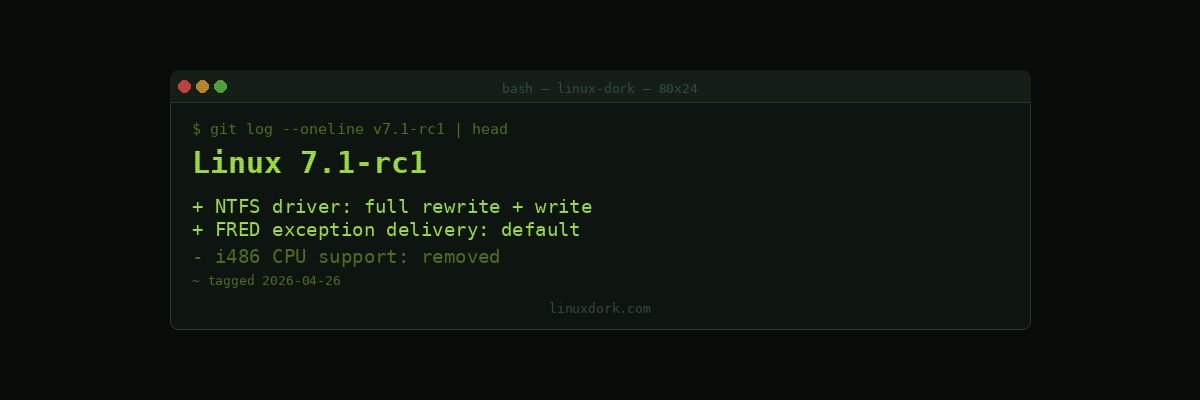
Linux 7.1-rc1: NTFS Gets a Full Rewrite and the i486 Finally Retires
Linus Torvalds tagged Linux 7.1-rc1 on April 26, 2026, opening the next development cycle just two weeks after Linux 7.0 shipped. RC1 is a snapshot of what merged during the two-week merge window, the busiest period in each kernel development cycle when feature patches land. The final 7.1 release is expected around June 14–21, 2026 depending on how many release candidates are needed.
NTFS Driver: A Four-Year Rewrite Ships
The most significant 7.1 change is a complete replacement of the kernel’s NTFS driver. The old driver, which has been in the kernel since 2001, was read-only, unmaintained, and architecturally incompatible with modern kernel infrastructure. The new driver, developed over four years by Konstantin Komarov at Paragon Software, provides:
- Full read/write support: no more mounting NTFS as read-only or relying on FUSE-based
ntfs-3gfor writes - Delayed allocation: writes are buffered and committed in larger blocks, matching how modern filesystems handle I/O efficiently
- Modern kernel integration: uses current VFS interfaces, page cache, and block layer properly
- Compression support: reads compressed NTFS files transparently (write compression is not yet supported)
The old ntfs module is still present for now but deprecated. Distributions will likely migrate to the new ntfs3 driver as default over the coming releases. For dual-boot setups and external Windows drives, ntfs3 is a material quality-of-life improvement over the userspace ntfs-3g alternative.
To mount NTFS with the new driver explicitly:
mount -t ntfs3 /dev/sdXY /mnt/windowsMost distributions will handle this transparently via udev rules once they adopt 7.1.
FRED: Flexible Return and Event Delivery Now Default
FRED (Flexible Return and Event Delivery) is now enabled by default on supported x86-64 hardware. FRED is Intel’s replacement for the legacy interrupt/exception delivery mechanism, providing:
- A simpler, more consistent model for delivering exceptions, interrupts, and system calls to the kernel
- Reduced overhead for interrupt-heavy workloads
- Better foundation for future security hardening
FRED requires hardware support (Intel processors from roughly 2023 onwards). On older hardware the kernel falls back to the traditional mechanism automatically. The performance improvement is workload-dependent but measurable in high-interrupt-rate scenarios like network-intensive servers.
i486 Support Removed
Linux 7.1 drops support for Intel’s 486-class processors, hardware from 1989. The 486 lacks several instructions that Linux has used for years, requiring special workarounds in the kernel that add complexity and maintenance burden for zero real-world benefit.
No commercially relevant hardware uses a 486 or compatible CPU in 2026. Embedded systems that might have used 486-class cores migrated to ARM or RISC-V decades ago. The removal simplifies the x86 architecture code and removes some code paths that haven’t been tested on real hardware in years.
AMD GPU Driver Sync
Roughly 25% of the 7.1-rc1 patch volume is an AMD GPU register header synchronisation, a bulk update bringing the in-kernel headers in line with AMD’s hardware specification documents. This is routine maintenance that enables new hardware features and fixes discrepancies between the driver and actual hardware behaviour, but it produces a large diff that makes the RC look more dramatic than it is.
What to Expect Before Final Release
The 7.1 merge window is closed with rc1. The remaining rc2–rc7 (or rc8) cycle focuses on bug fixes, regression resolution, and driver stability. If you’re tracking current kernels, linux-next and the stable rc releases are the place to watch. Arch Linux and Gentoo users typically see rc kernels available in testing repositories within days of each tag.