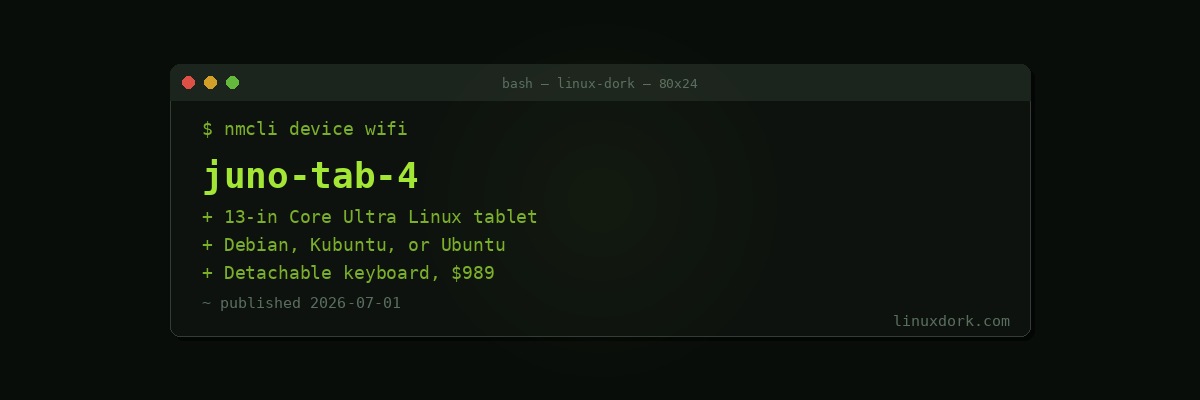
Juno Tab 4 Brings a 13-Inch Intel Core Ultra Linux Tablet to Market at $989
Genuine Linux tablets are still rare enough that a new one is notable on its own. Juno Computers released the Juno Tab 4 in two distinct configurations, a premium 13-inch WiFi model and a more compact 10.5-inch LTE model, both shipping with a real choice of Linux distributions rather than a single locked-down image.
The 13-Inch WiFi Model
lscpu | grep "Model name"The flagship 13-inch model runs an Intel Core Ultra 5 115U (Meteor Lake), 8 cores and 10 threads, up to 4.2 GHz with Turbo, paired with Intel Arc Xe-LPG integrated graphics. The display is a 2K panel at 1600×2560, 60 Hz, 500 nits brightness, in a 3:2 aspect ratio with 10-point capacitive touch, a taller, more document-friendly ratio than the 16:9 or 16:10 panels typical of most tablets.
Memory and storage are generous for the category: 16 GB of 6400 MHz DDR5 and a 1 TB M.2 2280 NVMe SSD over PCIe 3×4. Connectivity includes Realtek RTL8852BE Wi-Fi 6 and Bluetooth 5.2, two USB-C 3.1 ports supporting charging, video out, and OTG, plus a USB-A 3.0 port, a notably fuller port selection than most tablets offer regardless of operating system.
nmcli device wifi listThe chassis is magnesium-aluminum alloy with dual stereo speakers and active dual-fan cooling, and a detachable, backlit US-English keyboard doubles as a magnetic protective sleeve when not in use. It’s available to pre-order for $989 USD.
The 10.5-Inch LTE Model
The smaller model targets portability and cellular connectivity over raw performance. It runs an Intel Celeron N300 (Alder Lake-N), 8 cores and 8 threads, 7W TDP, up to 3.8 GHz Turbo, with 12 GB of LPDDR5 and a 1 TB M.2 2242 SATA III SSD. The display is a 10.5-inch anti-glare touchscreen at 1920×1280, 60 Hz, with the same 10-point capacitive touch as the larger model, though notably it’s SATA rather than NVMe storage, a meaningful performance step down from the 13-inch model that’s worth weighing against the LTE model’s smaller footprint and built-in cellular option.
Operating System Choices
cat /etc/os-releaseBoth models ship preinstalled with a genuine choice of Linux distributions rather than a single vendor image: Debian GNU/Linux 14 “Forky” with a choice of GNOME, KDE Plasma Mobile, or Phosh, Kubuntu 26.04 LTS with KDE Plasma, or Ubuntu 26.04 LTS with GNOME. The inclusion of Plasma Mobile and Phosh alongside conventional desktop GNOME and KDE builds acknowledges that a tablet form factor benefits from a touch-first shell rather than a desktop environment adapted after the fact, while still giving buyers who prefer a familiar desktop-style interface that option too.
Why This Matters
Linux tablets running full desktop distributions, rather than Android forks or single-purpose embedded images, remain a small category dominated by a handful of vendors. A device offering real NVMe storage, a 2K display, and a genuine multi-distro choice at the 13-inch tier puts real pressure on that short list, particularly for anyone who has wanted a tablet that runs the exact same Debian or Ubuntu environment as their desktop rather than a mobile-adapted variant.