TUXEDO OS Will Track Debian Testing Kernels and Layer Its Own Hardware Fixes on Top
TUXEDO Computers has detailed the kernel strategy for its Debian-based OS, following July’s announcement that it was dropping Ubuntu for Debian Testing under what it calls a Continuous Debian model.
The approach
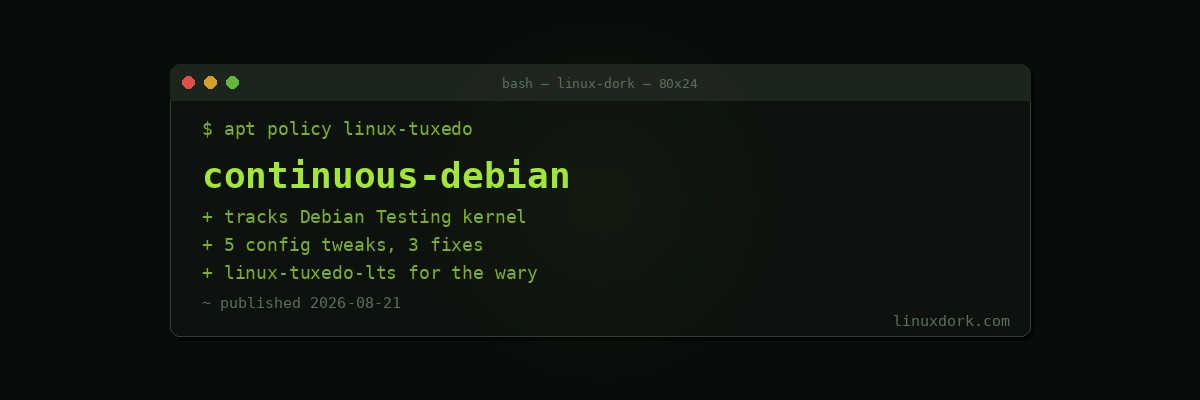
Future linux-tuxedo kernels will be based on whatever kernel version is in Debian Testing, which generally tracks the latest upstream stable release with a short delay. On top of that base, TUXEDO applies a small number of its own patches and configuration changes aimed at hardware compatibility and performance on its own systems.
The current set is deliberately modest: five performance-focused kernel configuration changes and three bug fixes.
The three fixes are specific and tell you what a hardware vendor actually deals with:
- Notebook display backlight controls
- Preventing rare hard resets on Intel-based InfinityBook Pro Gen8 laptops
- Fixing negative V-Blank values in the Intel i915 driver
None of those are glamorous. All of them are the difference between a laptop that works and a laptop that a customer returns.
Why this is the right amount of patching
The interesting thing here is the restraint.
A hardware vendor shipping its own Linux distribution faces a real temptation to maintain a heavily patched kernel, because that is the fastest route to making the hardware work. It is also a trap: every patch is a permanent maintenance obligation, every rebase gets harder, and you end up years behind upstream carrying fixes nobody remembers the reason for.
Eight total changes on top of a Debian Testing base is a strategy that stays sustainable. It also implies the patches are being upstreamed rather than hoarded, since a small and stable patch count is what you get when fixes eventually land in mainline and drop off your list.
Compare with the direction Garuda and Bazzite went this month, both retiring custom kernels in favour of a shared one. Different problem, same underlying conclusion: maintaining your own kernel is expensive and worth avoiding where you can.
The LTS option
TUXEDO will also provide linux-tuxedo-lts, based on a long-term support kernel release, for users who prefer a more conservative update path.
That is the right call for a vendor whose customers include people who bought a laptop to do work on it. Tracking Debian Testing kernels is great for hardware support and less great if you need the machine to behave identically next month.