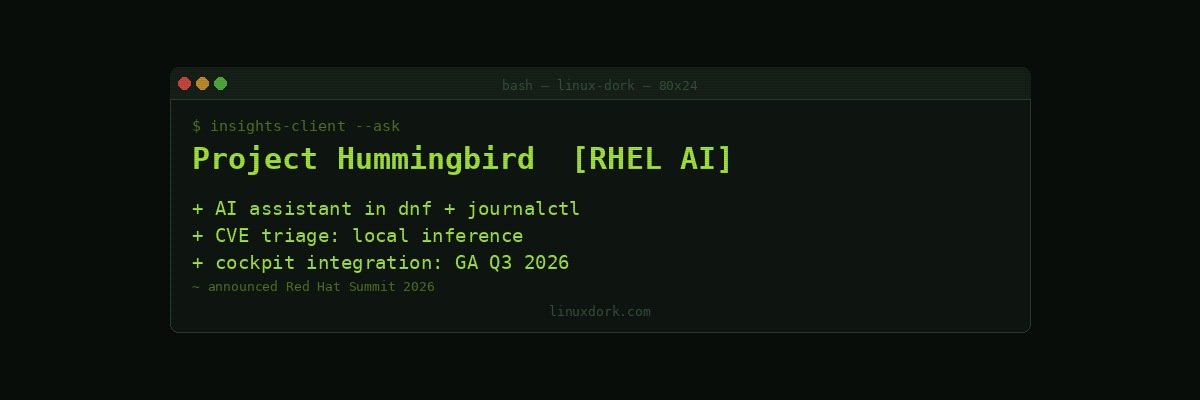
Red Hat's 'Project Hummingbird' Brings AI-Assisted Linux Administration to RHEL
Red Hat announced Project Hummingbird at Red Hat Summit 2026, held in Boston April 28–30. The project integrates an AI assistant into Red Hat Enterprise Linux’s core administration tooling (dnf, journalctl, insights-client, and cockpit) with the goal of reducing the expertise gap for common sysadmin tasks without requiring cloud-connected LLM calls for sensitive workloads.
What Project Hummingbird Does
Hummingbird is not a chatbot bolted onto a terminal. Red Hat describes it as a context-aware assistant embedded in the tools sysadmins already use:
In dnf: When an update includes a CVE fix, Hummingbird provides a one-line plain-language summary of the vulnerability and its exploitability conditions alongside the package changelog. Admins can run dnf advisory-explain CVE-2026-XXXX to get detailed context without leaving the package manager.
In journalctl: Hummingbird surfaces pattern analysis across log entries when you pass --ai-summarise to a journalctl query. It groups related errors, identifies recurring patterns, and suggests likely root causes drawn from Red Hat’s knowledge base of known issues and the system’s installed package versions.
In Cockpit: A new sidebar in the Cockpit web interface shows real-time recommendations based on system state, flagging misconfigured SELinux policies, expired certificates, services in a restart loop, and kernel parameters that deviate from Red Hat’s performance tuning guidance for the detected workload profile.
On-Premises Inference
The sensitive nature of log data and system configuration means Red Hat built Hummingbird to run inference locally rather than routing data to external APIs. The assistant uses a distilled model (currently based on Granite 3.2 Instruct) that runs on CPU without GPU hardware, consuming roughly 4GB RAM when active.
The model is distributed as an RPM package (rhel-hummingbird-inference-engine) and runs as a systemd socket-activated service, it only starts when a tool requests a response and shuts down after a configurable idle timeout. No data leaves the system unless you explicitly enable the optional Red Hat Insights cloud connection.
Red Hat Insights Integration
For organisations already using Red Hat Insights (the cloud-connected subscription telemetry service), Hummingbird can optionally forward anonymised query context to improve recommendation quality. This is opt-in, requires explicit configuration, and is separate from the default local-only mode.
Availability
Project Hummingbird is in Technology Preview for RHEL 9.6 and RHEL 10.0, expected to ship as Generally Available in RHEL 10.1 later in 2026. CentOS Stream 10 users will receive it via the standard CentOS update stream as the preview progresses.
Fedora users can install the Fedora variant (fedora-ai-assistant) from Copr repositories, a less polished preview that tracks the upstream development branch.
The Broader Context
Red Hat’s announcement comes in the same week as Canonical’s integration of LLM-based tools in Ubuntu 26.04 and Fedora 44’s NTSYNC gaming improvements. The Linux ecosystem is absorbing AI tooling at the distribution and infrastructure layer faster than expected, with each major vendor taking a different approach: Canonical via opt-in cloud-connected tools, Red Hat via on-premises inference, and Fedora via community Copr experimentation.
For sysadmins managing RHEL fleets, Hummingbird in Cockpit looks like the most immediately practical feature, turning what previously required a Red Hat support call or a trip to access.redhat.com into a local, fast, context-aware prompt response.