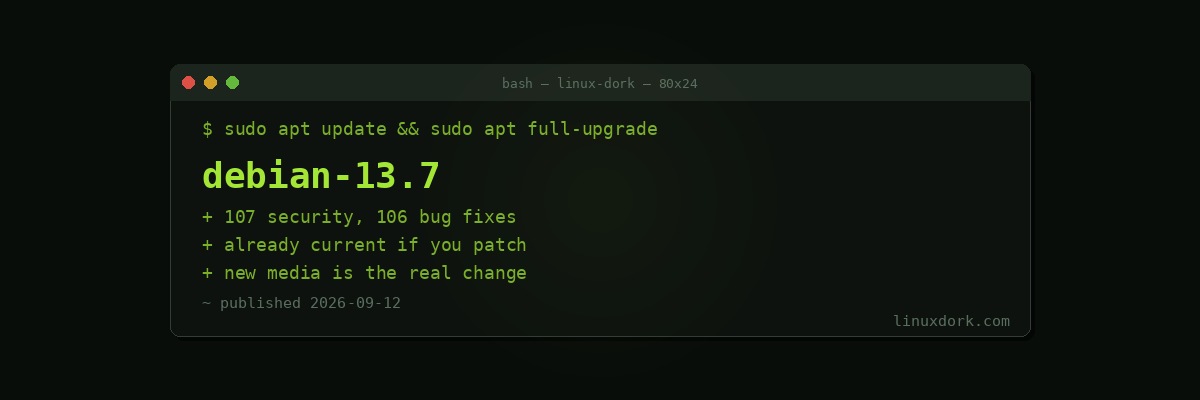
Debian 13.7 Released with 107 Security Updates and 106 Bug Fixes
Debian 13.7 is out, carrying 107 security updates and 106 bug fixes.
What a Debian point release is
It is worth restating because it is routinely misunderstood: a Debian point release is not a new version. It does not add features, change behaviour, or upgrade packages to newer upstream releases.
It is a roll-up. Every fix that has already been published through security.debian.org and stable-updates is folded into the main archive and into refreshed installation media, so a new install starts from a current base rather than immediately downloading several hundred updates.
If you have been applying updates, you are already running 13.7. There is nothing to do.
# confirm
cat /etc/debian_version

# if this pulls nothing significant, you were current
sudo apt update && sudo apt full-upgrade
The thing that actually changes is the installation media. Anyone imaging machines, building golden images, or deploying at scale should pull the new ISOs, because starting from 13.7 rather than 13.0 removes a meaningful chunk of first-boot patching.
The stability argument, demonstrated
107 security updates and 106 bug fixes across several months, on a release supporting tens of thousands of packages, with essentially no behavioural change: that is the Debian stable proposition working exactly as advertised.
You are not getting new features. You are getting a system where the thing that worked last month works this month, and where the only changes are fixes for things that were wrong. For infrastructure, that is usually what you want, and it is why CERN chose Debian for its accelerator control systems where a predictable release cadence was a hard requirement.
The corresponding cost is package age. Debian stable ships what was current at freeze, and by mid-cycle that is noticeably behind. For a desktop, backports help; for a workstation that needs current toolchains, stable is the wrong choice and always has been.
Also worth noting
This lands in the same fortnight that Debian 11 “Bullseye” went end of life. If you have Bullseye systems, 13.7 is where you are eventually heading, via Bookworm.
Debian also resolved its General Resolution on generative AI last month, landing on responsible use with human accountability rather than a ban.
Full details are in the Debian announcement.