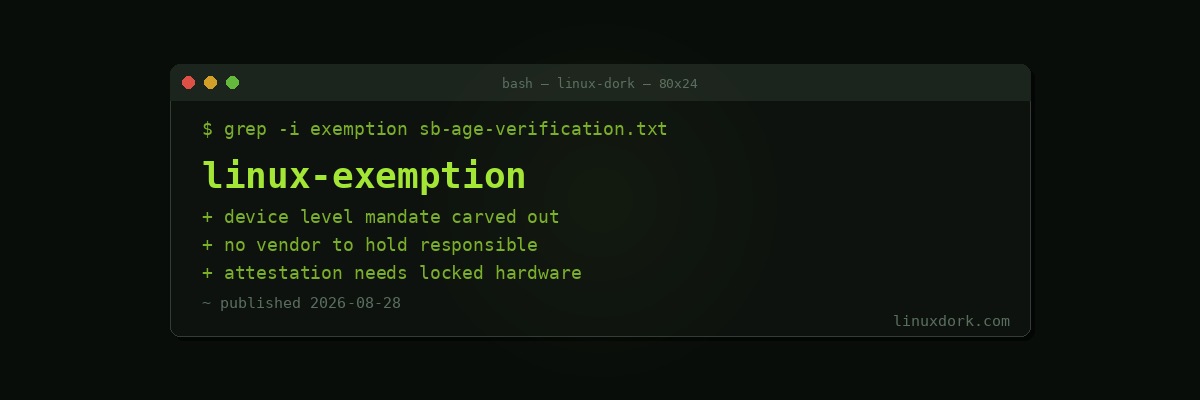
California's Age Verification Bill Passes with the Linux Exemption Intact
California’s age verification bill has passed with an exemption preserved that matters to anyone who builds or runs an operating system without a corporate legal department behind it.
Age verification laws have proliferated across jurisdictions, and the technically significant ones are those that push the obligation down to the operating system or device layer rather than leaving it with individual websites. Those are the versions that create a problem for Linux.
Why device-level requirements are a problem for Linux
A requirement that an operating system attest to a user’s age assumes a particular shape of computing: a signed OS from an identifiable vendor, an account system tied to a verified identity, and an attestation path the vendor controls end to end.
Linux does not have that shape and mostly cannot acquire it:
There is no vendor for most installations. A self-compiled kernel on a self-assembled distribution has no company to hold responsible. Compliance obligations assume an entity that can be obligated.
Attestation requires a root of trust the user does not control. A meaningful age attestation has to be something the user cannot forge, which on a general-purpose computer means hardware-backed attestation with keys the owner cannot reach. That is in direct tension with owning your machine, and it is the mechanism that makes the requirement enforceable at all.
Identity binding breaks the anonymity model. Most Linux installations have no account tied to a legal identity anywhere, which is a feature rather than an oversight.
An unexempted device-level mandate would leave distributions in a position where compliance is impossible and non-compliance is a legal exposure. The realistic outcomes are that hobbyist and open-source systems become technically unlawful in the jurisdiction, or that general-purpose computing is quietly narrowed to platforms that can attest.
What the exemption does
The exemption carves out open-source and hobbyist operating systems from the device-level obligations, keeping the requirements on commercial platform vendors who already have the identity and attestation infrastructure the law assumes.
That is the right technical shape for the rule, whatever one thinks about age verification as policy. The people who drafted it understood that a mandate written for iOS and Android becomes something quite different when applied to a category of software with no vendor.
Worth watching rather than celebrating
One exemption in one state is narrow. Similar legislation is moving in other US states and in other countries, drafted by people with varying degrees of familiarity with how operating systems that nobody sells actually work. Each one is a separate opportunity for the exemption to be absent.
The precedent helps. A large jurisdiction has now considered the question and concluded that hobbyist and open-source systems need carving out, which is a reference point advocates can cite elsewhere.
For readers outside California, the useful takeaway is that this class of legislation is where Linux’s legal position gets decided, and that it gets decided by whether anyone technical is in the room when the text is drafted.
Anyone interested in the wider policy work here should look at the EFF and the Software Freedom Conservancy, who track this kind of legislation.