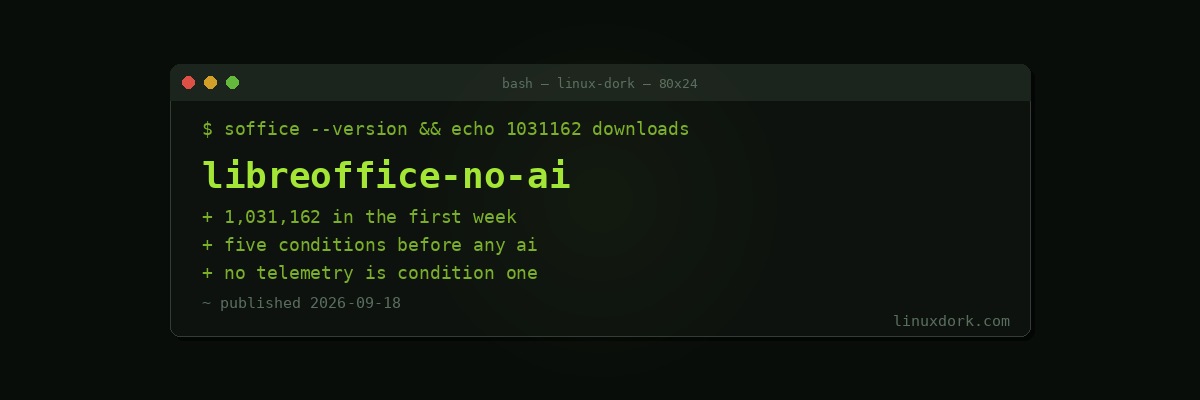
LibreOffice 26.8 Passes a Million Downloads in a Week as TDF Says No AI Is a Feature
LibreOffice 26.8 was downloaded 1,031,162 times from the project’s official download page in its first week, the strongest opening of any release in LibreOffice’s history. That figure excludes everyone who got it from a distribution repository, which on Linux is most people.
A day later, The Document Foundation published a post titled “Yes, no AI is now a feature.”
The position
TDF is careful to say it is not rejecting AI as a technology. The argument is about defaults, and about who LibreOffice’s users are.
The suite is deployed in schools, hospitals, public institutions, and law firms. TDF’s position is that software used in those settings should not acquire AI in its default configuration unless the implementation meets the project’s existing principles. It then listed what those are.
No telemetry. LibreOffice collects no usage data, and any AI feature would have to hold that line. This is the one that rules out most current integrations immediately, since the usual model involves sending content to a service.
Provider independence. A feature wired to a single company’s API is lock-in. Any integration would need open interfaces capable of working with multiple backends.
Document format integrity. AI-generated content would have to stay in OpenDocument Format and preserve structure, styles, and semantics, rather than introducing a dependence on a proprietary format.
Genuinely optional. Administrators must be able to install or remove it; users who do not want it should not see it in the interface at all. Not a toggle buried in preferences, absent.
Suitable for the full support lifecycle. Whatever ships has to remain supportable across a LibreOffice release lifetime, which is a much longer commitment than a feature that depends on a third-party API that may change or disappear.
TDF’s conclusion is that no current integration meets all five while being appropriate as a default. So LibreOffice continues to ship without built-in AI.
The part that makes it a real argument
The strongest passage is about incentives, and it is uncomfortable for the competition.
TDF points out that subscription-funded office suites have direct commercial reasons to add AI assistants: higher-priced tiers, and tighter coupling to the vendor’s cloud. A nonprofit has none of those pressures and can simply wait.
That is a genuine structural difference rather than a marketing claim. Whether you find it persuasive probably depends on whether you think the AI features in commercial suites were driven by user demand or by the need to justify a price increase, and reasonable people land differently on that.
The counter-argument is also worth stating: users who want these features have to go elsewhere for them, and “wait until it meets our principles” can become indefinite. TDF has left the door open, saying it will reassess as local inference gets easier on ordinary hardware and open models improve, which is a specific enough condition to be checkable later.
If you want it anyway
Third-party extensions exist, including ones that connect to locally running models through Ollama, LM Studio, and OpenAI-compatible endpoints. They are maintained independently of TDF.
The local-inference route is the interesting one here, because it satisfies most of TDF’s objections by construction: nothing leaves the machine, there is no provider dependence, and it is opt-in by definition. Our guide to running LLMs locally with Ollama covers what that involves and what the hardware actually needs to be.
Against the rest of the week
This lands in an unusually pointed week for open-source AI policy.
Debian resolved its General Resolution in favour of responsible use with human accountability. Void Linux lost a maintainer and 113 packages over a stricter reading of a similar rule. And TDF is positioning the absence of the feature as a selling point, with a million downloads in the same week to point at.
Those three are not really in conflict, because they answer different questions. Debian and Void are about contributions, meaning what maintainers accept. TDF is about product, meaning what ships to users.
A project can reasonably use AI tooling internally and decline to put it in the interface, and vice versa. Conflating the two is going to cause a lot of confused argument over the next year, and this week is a decent illustration of why keeping them separate matters.
The release itself, with its new paragraph composer and variable font support, is covered separately.