Windmill: Turn Scripts Into Workflows and UIs
Windmill is for automation where you would rather write a script than drag nodes around.
Code first, UI generated
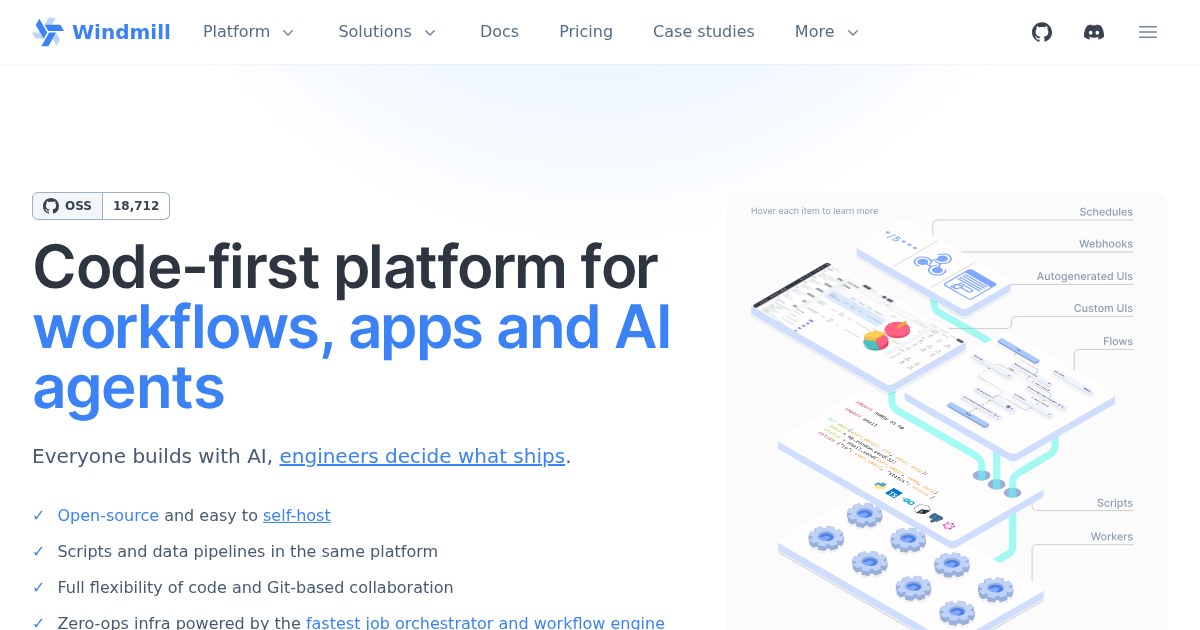
Write a function with typed parameters. Windmill reads the signature and generates a form, an API endpoint, a schedule option and a webhook for it.
def main(hostname: str, port: int = 443, verbose: bool = False):
    # Windmill renders a form with a text field, a number
    # defaulting to 443, and a checkbox
    ...
That inversion is the appeal. n8n, Activepieces and Automatisch are node-graph tools where code is an escape hatch. Windmill is a code tool where the graph is for composition.
For anyone comfortable writing a script, Windmill removes the part that is actually tedious: the form, the auth, the scheduling, the logging.
Languages
Python, TypeScript, Go, Bash, SQL and more, with dependencies resolved automatically from imports. Our bash scripting guide and Python versions guide cover the two most used.
Flows and apps
Flows chain scripts with branching, loops, error handlers, approval steps and retries. Apps are a drag-and-drop UI builder over the same scripts for when a generated form is not enough.
The approval step is worth noting: a flow can pause and wait for a human, which is how you build an automation you are willing to let touch production.
Where it fits for a self-hoster
The honest comparison is with a directory of shell scripts and a systemd timer, which is what most of us have.
Windmill is worth it when you want other people to run your scripts, when you need an audit trail of who ran what, or when the scripts have grown dependencies and secrets that deserve managing. Below that, our flock and mktemp guide and a timer are less machinery.
Operational notes
Rust server with PostgreSQL, plus workers that execute jobs. Our PostgreSQL guide covers the backend, and workers are where the resource usage lives.
Operational caution
It executes arbitrary code and holds secrets, which makes it as privileged as anything in your estate. Give workers their own unprivileged user, scope the credentials it stores, and keep it off the public internet. Our secrets management guide and service hardening guide apply.
License
Windmill is released under the GNU Affero General Public License v3, with some enterprise features under a commercial licence.