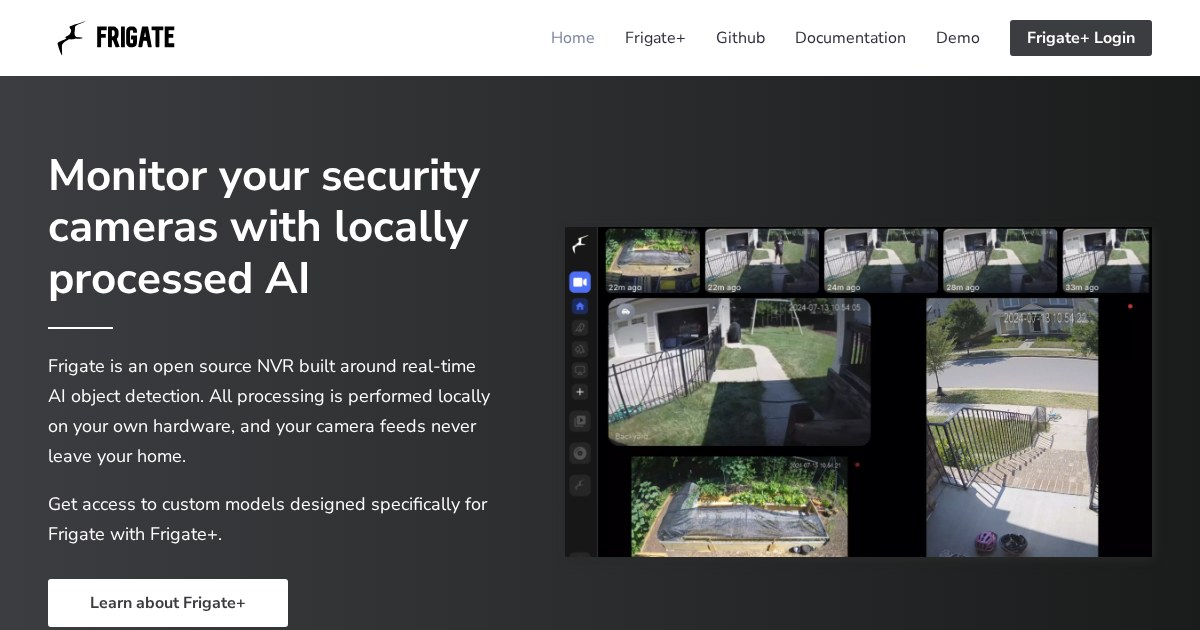
Frigate: Local Object Detection NVR
Frigate records IP cameras and runs object detection on the feeds locally, so alerts fire for people and cars rather than for trees moving in the wind.
Why detection changes everything
Motion-triggered recording is nearly useless outdoors: rain, headlights, shadows, and cats generate constant false alerts until you stop reading them. Frigate runs a real object detection model on each frame and only records and alerts when it identifies something you care about. That is the difference between a camera system you check and one you ignore.
Hardware is the main planning decision
Detection is compute-intensive. Frigate is built around Google Coral TPU accelerators, which handle many cameras at a few watts and cost very little, and this is the recommended path. Modern Intel iGPUs via OpenVINO and NVIDIA GPUs also work. Running detection on a CPU alone is possible for one or two cameras and will otherwise saturate the machine.
Camera settings matter too: Frigate expects a high-resolution stream for recording and a low-resolution substream for detection, which nearly all IP cameras provide.
Integration
Frigate integrates tightly with Home Assistant, exposing cameras, detected objects, and snapshots as entities that automations can act on. MQTT is the transport, so Mosquitto is part of a typical deployment.
Storage
Continuous recording of several cameras consumes disk quickly. Frigate’s retention settings distinguish between continuous footage and detected events, and configuring those deliberately is what keeps a system sustainable rather than filling a drive in a fortnight.
Alternatives
Scrypted emphasizes HomeKit and platform integration. Shinobi and ZoneMinder are established NVRs with weaker detection.
License
Frigate is released under the MIT License.