QEMU 11.1 Adds RISC-V Big-Endian Targets and Nested Virtualization for the hvf Accelerator
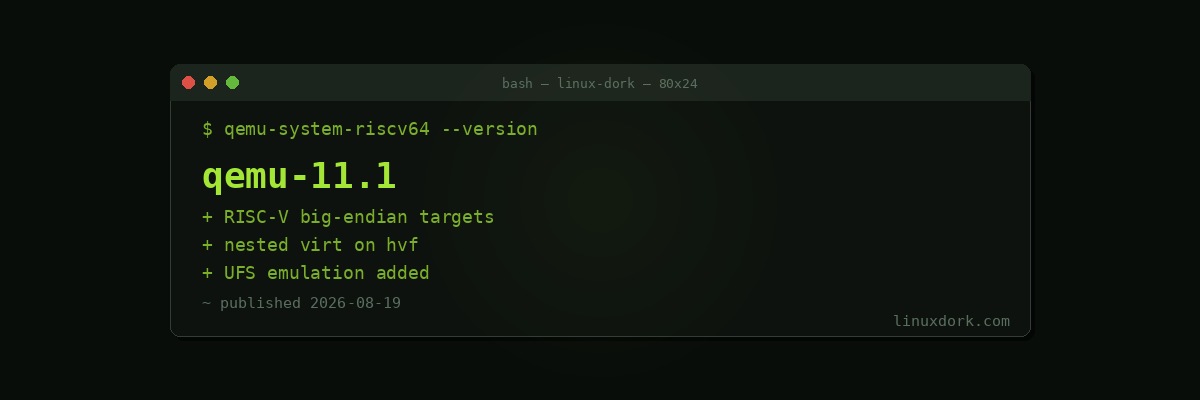
QEMU 11.1.0 was released on August 11 as the first maintenance update to the 11.x series, and the headline change is RISC-V big-endian target support.
RISC-V
Big-endian RISC-V is a niche target and a useful one. RISC-V is little-endian in its common configurations, but the specification permits big-endian operation, and there is no good way to develop or test software for that mode without an emulator that supports it. QEMU adding the target is what makes that work possible at all for most people.
The release also expands ISA coverage considerably:
- Draft Zbr extension support
- Zvfbfa
- KVM support for Zicbop and BFloat16 extensions
- Fractional LMUL handling for vector SHA instructions
On the machine side, QEMU 11.1 adds support for the K230 board, updates OpenSBI to 1.8.1, and introduces Tenstorrent mvendorid support.
The pattern here is familiar for anyone who has watched an architecture mature. QEMU support routinely lands before silicon is broadly available, which means the software ecosystem can be built and tested against extensions that most developers cannot buy hardware for yet.
ARM
The hvf accelerator now supports nested virtualization and vGIC.
Nested virtualization means running a hypervisor inside a VM, which sounds like a curiosity until you need to test virtualization software, run containers-in-VMs stacks, or do kernel development on virtualization code without dedicating physical hardware to it.
The release also adds support for new architectural CPU features and the ability to specify cache topology on the virt board. Cache topology control matters for anyone benchmarking inside VMs, since a guest that misreads the cache hierarchy will make bad scheduling decisions.
UFS emulation
QEMU 11.1 adds Universal Flash Storage emulation. UFS is the storage interface used in most modern phones and increasingly in embedded systems, and being able to emulate it removes a hardware dependency for anyone working on UFS drivers or on firmware that talks to it.
Getting it
# Check version
qemu-system-x86_64 --version

# Arch
sudo pacman -Syu qemu-full

# Fedora
sudo dnf upgrade qemu

# Debian and Ubuntu
sudo apt update && sudo apt install --only-upgrade qemu-system
Distribution packaging varies in how quickly QEMU point releases land, and Debian stable in particular will be some way behind.