Miracle-WM 0.11 Adds a Workspace Overview Mode
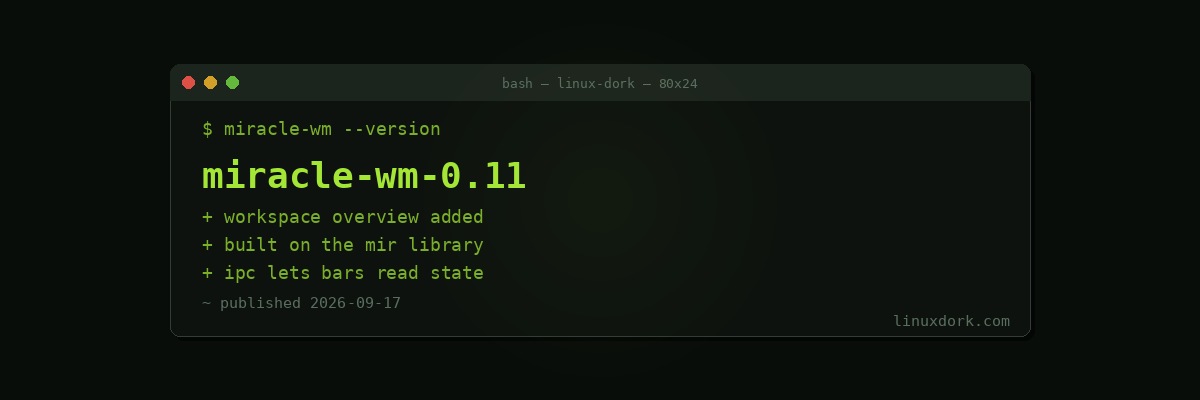
Miracle-WM 0.11 adds an overview mode for selecting windows and workspaces, along with window urgency support and IPC improvements.
What Miracle-WM is
A tiling Wayland compositor built on Mir, which is Canonical’s display server library.
Mir’s history is worth a note. It began as Canonical’s alternative to Wayland during the Unity 8 and Ubuntu Touch period, and after that was abandoned it was rebuilt as a library for constructing Wayland compositors rather than a competing protocol. That second life turned out to be the useful one: it handles the difficult parts of being a compositor, input, output management, buffer handling, protocol implementation, so a project can focus on window management policy.
Miracle-WM is what you get when someone builds an i3-style tiling manager on that foundation rather than from scratch.
Overview mode
The feature tiling users borrow from full desktop environments, and it addresses a genuine weakness.
Tiling is excellent while your windows fit on screen and degrades once you have several workspaces, because everything not currently displayed is invisible. You either remember which workspace has your terminal or you cycle through looking for it.
An overview showing all windows and workspaces at once solves that directly. GNOME’s Activities is the well-known example, and its value is highest precisely where tiling is weakest.
Window urgency is the complementary feature: an application signalling it needs attention, so a notification on another workspace is discoverable rather than silently waiting.
IPC
Improved inter-process communication, which is what makes a compositor scriptable. Status bars query it for workspace state, and scripts use it to move windows and change layouts.
i3 and Sway established this pattern, and it is a large part of why they have ecosystems around them. A compositor without usable IPC cannot have a third-party bar or workspace indicator.
The Wayland compositor landscape
There is a lot happening in this space, which our recent coverage reflects: Niri’s scrolling model, Noctalia reaching stable as a shell layer, and now Miracle-WM.
The pattern across all of them is a separation of concerns that X11 window managers never had cleanly. The compositor handles window management; a separate shell provides panels, launchers, and notifications. That is more modular and it means a new compositor does not have to build an entire desktop to be usable.
The tradeoff is the one this site keeps returning to: smaller compositors have very limited accessibility support, because under Wayland those features must be implemented by the compositor and that is substantial work for a small project.
Our Wayland and X11 explainer covers the architectural difference driving all of this.