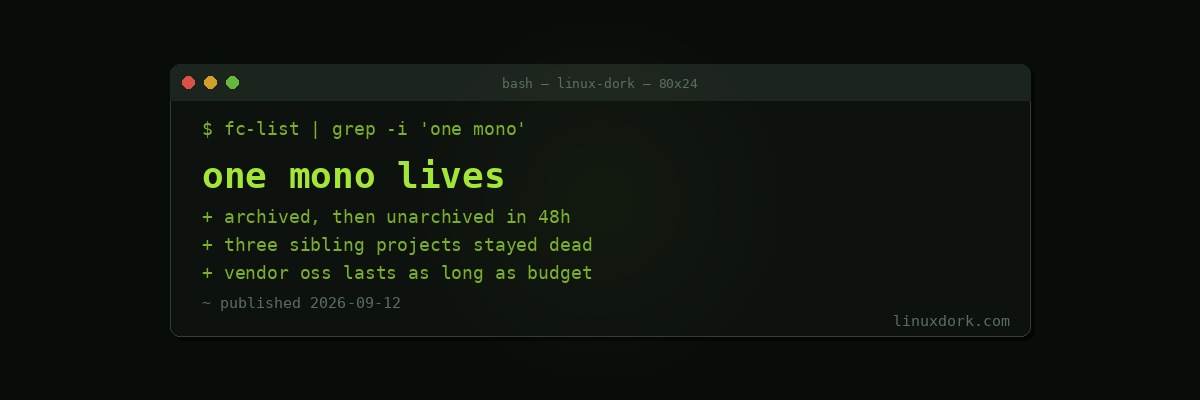
Intel Archived Its Developer Font, Then Unarchived It Two Days Later
Intel archived Intel One Mono this week, then reversed the decision two days later.
The font is not the story. The pattern around it is.
What One Mono is
Intel released One Mono in 2023 as an open-source monospaced family built explicitly for developers, with an emphasis on legibility and on disambiguating the characters that cause real problems in code. Anyone who has spent a session confusing l with I or 0 with O knows why a font designed for this exists, and it is the same class of problem that turns a mistyped identifier into an afternoon of debugging.
A CPU vendor shipping a typeface was an odd thing in 2023 and remains one. It was competent work regardless.
The archive and the reversal
One Mono has not had a real code change since July 2024. The only 2025 activity was README edits. On any reasonable maintenance metric it was already finished, which made archiving it unremarkable.
Then, roughly 48 hours later, the archive was reverted with no public explanation. The repository is live again on GitHub, and Intel is nominally still maintaining it.
An unexplained reversal is usually one of two things: somebody noticed externally and Intel decided the goodwill was worth more than the line item, or somebody internal objected and won. Either way it is a rounding error against Intel’s actual cost base, which makes the initial decision the more interesting one.
The projects that stayed archived
Three others went the same week and did not come back:
- Intel AMX Detection, a Python script for detecting Advanced Matrix Extensions support on a processor
- Intel Media Driver Helper, a documentation archive for the GPU-accelerated media driver
- Masked Occlusion Culling, game development code from Intel’s GameTechDev group
Those sit inside a two-year contraction that has already taken in open-source AI work such as BigDL, the quantum intrinsics project, and Ansible code for the discontinued Optane line.
The part that matters
The lesson is not about Intel specifically. A vendor-published open-source project has a lifespan tied to the vendor’s budget and to whether the engineer who cared about it still works there, and neither of those is visible from the outside until the repository goes read-only.
For a font, that is fine. Fonts are static assets. A ten-year-old font file works exactly as well as a new one, and the licence does not expire when the repository is archived.
For a detection script, a driver helper, or anything that has to track evolving hardware, an archive notice is the beginning of a slow failure. It keeps working until the hardware moves, and then it does not.
Practical takeaway if you depend on vendor-published open source:
# vendor your dependencies rather than relying on upstream availability
git clone --depth 1 https://github.com/intel/intel-one-mono
Self-hosting assets rather than pulling them from a third party at page load is the same instinct applied to the web, and it is worth doing for reasons beyond project longevity: it removes a request to someone else’s infrastructure and the tracking that can come with it.
One Mono survives. Whether it survives the next round is a different question, and the answer has nothing to do with the quality of the font.