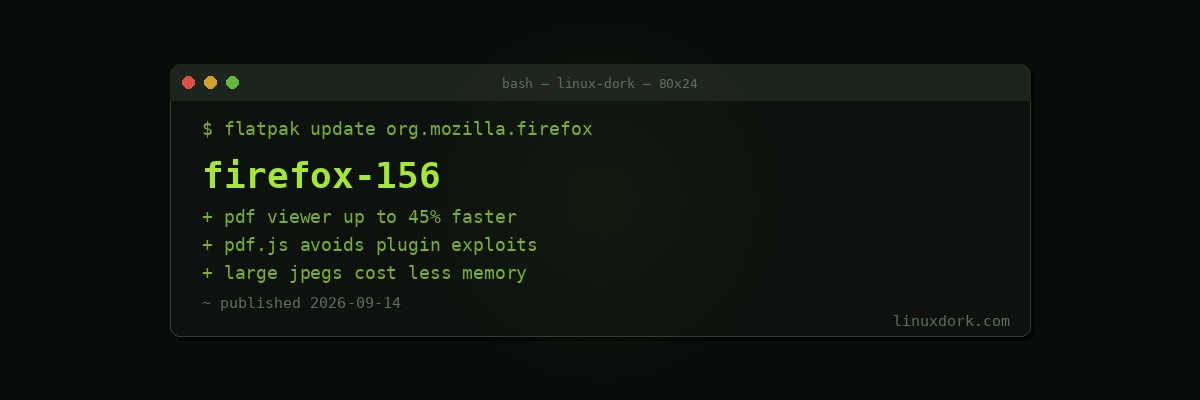
Firefox 156 Brings a PDF Viewer Up to 45 Percent Faster
Firefox 156 is out with a PDF viewer up to 45 percent faster, lower resource use on large JPEGs, Android improvements, and assorted fixes.
The PDF viewer matters more than it sounds
pdf.js renders PDFs in JavaScript inside the browser, with no native PDF plugin involved. That design decision is why Firefox has never had the plugin vulnerability class that made browser PDF handling a reliable source of exploits for a decade.
The cost has always been performance. A JavaScript renderer is doing work a native library would do faster, and on a large or complex document, a scanned book, a CAD export, a dense financial report, it showed.
A 45 percent improvement is the kind of number that changes whether people use the built-in viewer or download the file and open something else. For most Linux users the built-in viewer is the one they actually use, since it is what opens when you click a link.
Large JPEG handling is the other win, and it is a memory-pressure improvement. A tab holding several high-resolution images was disproportionately expensive, which on a machine without much RAM meant the browser was frequently the reason something got OOM-killed.
Thunderbird 156
Shipping alongside, with custom OAuth support for POP3, new enterprise policies, and fixes across IMAP, POP3, attachments, OpenPGP, and calendars.
The OAuth work continues a run that has been steadily making Thunderbird usable in corporate environments. 154 added Microsoft Graph support, 155 improved Exchange setup, and 156 extends custom OAuth to POP3.
Custom OAuth specifically means an organisation can point Thunderbird at its own identity provider rather than relying on the endpoints Mozilla ships. That is what makes deployment possible somewhere with an internal SSO setup, and it is the kind of requirement that silently disqualifies a mail client from enterprise use when it is missing.
Enterprise policies serve the same purpose: configuration an administrator can enforce centrally, which is the difference between software a company permits and software individuals install anyway.
Why the release cadence is worth noticing
Firefox 155 shipped September 2. Firefox 156 shipped September 14. That is a fast turnaround, and it reflects Mozilla’s four-week release cycle rather than anything unusual.
The steady cadence is part of why the “Firefox is slow” perception persists despite being years out of date: improvements arrive in small increments that individually do not generate headlines, and the cumulative effect is invisible to anyone who formed their opinion in 2016 and has not revisited it.
flatpak update org.mozilla.firefox org.mozilla.ThunderbirdGecko remains the only browser engine of consequence not derived from Chromium, which is the structural reason to care about Firefox beyond its feature list.