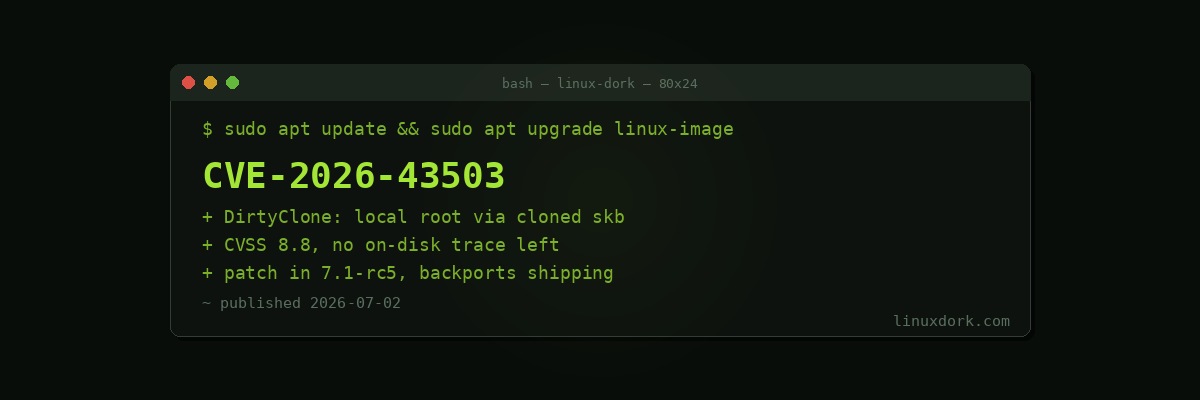
DirtyClone (CVE-2026-43503): The Kernel Privilege Escalation Bug That Leaves No Trace
CVE-2026-43503, dubbed DirtyClone, is a local privilege escalation in the Linux kernel with a CVSS score of 8.8. It lets any unprivileged local user obtain root, and unlike many kernel exploits it leaves nothing in kernel logs or on-disk audit trails, making it invisible to the integrity monitoring tools many servers rely on to catch tampering after the fact.
How It Works
DirtyClone is the fourth vulnerability discovered in what researchers are calling the DirtyFrag family, all of which share the same underlying failure: kernel code treats file-backed memory as if it were private packet data and performs an in-place modification instead of triggering a copy-on-write.
Specifically, kernel helper functions responsible for cloning network packets, primarily __pskb_copy_fclone() with skb_shift() also affected, fail to propagate the SKBFL_SHARED_FRAG safety flag. That flag exists to tell the kernel “this memory is shared, copy it before you write to it.” Without it, the kernel wrongly assumes shared file-backed pages are privately owned and writes to them directly.
The demonstrated exploit path loads a privileged binary such as /usr/bin/su into memory, wires those memory pages into a network packet, and forces the kernel to clone that packet through a loopback IPsec tunnel the attacker controls. The clone operation then corrupts the privileged binary’s in-memory pages, which the attacker can use to escalate to root.
Who’s Affected
Distributions that enable unprivileged user namespaces by default, including Debian, Fedora, and Ubuntu, are affected, since unprivileged namespaces are part of what makes the exploit reachable by a normal local user rather than requiring elevated starting privileges.
Patch Timeline
The combined upstream fix merged on May 21, 2026. CVE-2026-43503 was published two days later on May 23, and Linux 7.1-rc5, tagged May 24, was the first release to carry the fix. Because 7.1-rc5 predates the final 7.1 release by roughly three weeks, distributions tracking stable kernels needed an explicit backport rather than waiting for 7.1 to ship normally.
Canonical has published kernel updates for supported Ubuntu releases addressing DirtyClone, and the privacy-focused Tails distribution shipped 7.9.1 on a patched 6.12.94 kernel that folds in the fix alongside another privilege-escalation patch. Other major distributions with active kernel security teams, including Debian, Fedora, and SUSE, have followed with their own backports to supported kernel branches.
What to Do
Check your running kernel version against your distribution’s advisory for CVE-2026-43503 and apply the available kernel update. A reboot is required, since this is a kernel-level fix, not something a running system can pick up live.
# Debian/Ubuntu
apt list --upgradable | grep linux-image

# Fedora/RHEL
dnf check-update kernel

# Arch
pacman -Qi linux | grep Version
Because the exploit leaves no forensic trace, there is no reliable way to check after the fact whether a given system was compromised before patching. If DirtyClone is a plausible concern for a specific host (shared multi-tenant systems, systems exposing shell access to untrusted users), treat any window of unpatched exposure as a potential compromise rather than something you can rule out retroactively.