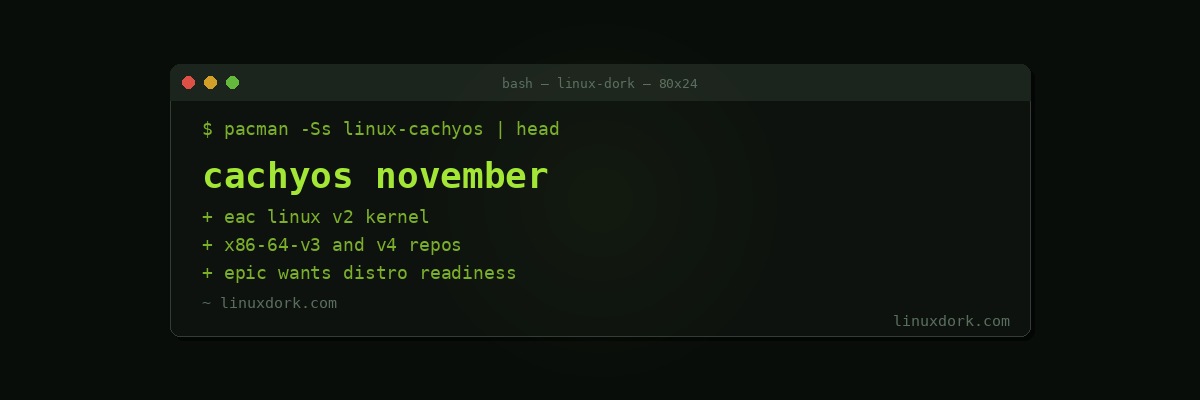
CachyOS November 2026 Release Adds an Easy Anti-Cheat v2 Kernel
CachyOS shipped its November 2026 release on November 22, with the notable addition being a kernel carrying what Easy Anti-Cheat Linux v2 needs. Kernel, Mesa and NVIDIA packages are all updated.
It follows the August release and continues the project’s monthly ISO cadence.
The anti-cheat piece
This is the interesting part, and it is a distribution reacting to something upstream.
Epic’s rebuilt launcher entered preview with native Linux support in October, alongside an upgraded Easy Anti-Cheat. Epic has said Fortnite follows “once it’s working with a critical mass of distro maintainers”, which is an unusual condition: the blocker is stated as distribution readiness rather than a date.
CachyOS getting the kernel side in place early is a direct response to that framing. Whether it ends up mattering depends on what Epic requires in practice, which is not yet fully specified.
The precedent is not encouraging and not hopeless either. Anti-cheat on Linux has repeatedly been a case of the technical capability existing while the publisher declines to enable it. Our gaming on Linux guide covers the state of play.
What CachyOS actually is
An Arch derivative built around performance tuning rather than a different philosophy. The differences from Arch are concrete:
- Kernels built with optimisations and alternative schedulers, including BORE and sched-ext variants
- x86-64-v3 and v4 package repositories, so binaries are compiled for instruction sets a modern CPU actually has rather than the 2003 baseline
- An installer, which Arch does not have in the same sense
- Gaming-oriented defaults, with Proton, Mesa and the graphics stack configured rather than assembled
The v3 and v4 repositories are the most defensible technical claim. Standard distribution packages target a baseline that predates AVX2 for compatibility reasons, so recompiling for newer instruction sets yields real gains in some workloads. “Real gains in some workloads” is also the honest framing: it is not a transformative difference across the board, and benchmarks that suggest otherwise are usually measuring something narrow.
Our Arch guide covers the base, and pacman guide the package manager, which CachyOS uses unchanged.
Updating
Existing installations do not need the ISO:
sudo pacman -Syu

# which kernel are you on, and what is available
uname -r
pacman -Ss linux-cachyos | head

# the EAC-capable kernel
sudo pacman -S linux-cachyos
New ISOs matter for fresh installs and for anyone whose system is far enough behind that an in-place update is awkward. On a rolling release, that is the usual reason to redownload, per our rolling release guide.
Being Arch-based, the AUR is available, with the same caveats it always carries.