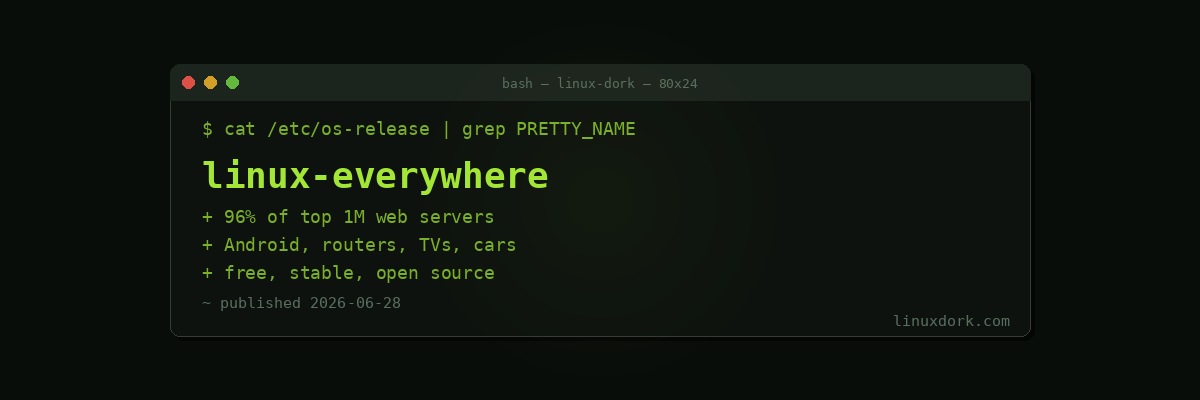
Why Linux Is Everywhere
Linux was not supposed to win. In 1991 it was a hobby project; by 2000 it was powering most of the internet; today it is the operating system of everything from your phone to the Mars helicopter. Understanding why helps explain what makes Linux different.
The numbers
Linux’s reach is difficult to overstate:
- Web servers: approximately 75-80% of all web servers run Linux; over 96% of the top one million sites
- Cloud: AWS, Google Cloud, and Azure all run primarily on Linux internally; most cloud VMs are Linux
- Smartphones: Android, built on the Linux kernel, has over 70% of global smartphone market share
- Supercomputers: 100% of the TOP500 fastest supercomputers run Linux (every single one since November 2017)
- Embedded systems: routers, smart TVs, car infotainment, streaming sticks, ATMs, medical devices
- Stock exchanges: the NYSE, London Stock Exchange, and most major financial market infrastructure run Linux
- Space: the Mars Ingenuity helicopter runs Linux; so does the Perseverance rover’s control system
Why it happened
1. The cost advantage was enormous
In the mid-1990s, a Unix licence for a commercial operating system cost thousands of dollars per server. Windows NT Server cost hundreds. Linux was free. For a startup building a web presence with a few servers, this was meaningful. For a company running thousands of servers, it was transformative.
The cost advantage compounds at scale. A cloud provider running a million virtual machines pays nothing for Linux licences. Running Windows Server on a million VMs would cost billions per year in licensing.
2. The GPL created a virtuous cycle
The GPL licence requires that modifications to Linux be released under the same licence. This sounds like a restriction, but it became a superpower: every improvement any company made to the kernel had to go back to the community. Companies that would otherwise have kept improvements proprietary were instead contributing them to the shared codebase.
This created a feedback loop. IBM, Red Hat, Intel, and others invested in Linux because they could customise it and benefit from everyone else’s improvements. Their contributions made Linux better for everyone. That made more companies adopt Linux, which brought more contributors, which made it better still.
3. The internet needed Linux
The World Wide Web exploded from nothing to mainstream between 1993 and 1997. Web servers needed an OS that was stable, cheap, and capable. The Apache web server (1995) ran best on Linux. The LAMP stack (Linux, Apache, MySQL, PHP/Perl/Python) became the default architecture for web applications and remained so for over a decade.
Once Linux was established as the web server OS, the tooling, documentation, expertise, and best practices all developed around Linux. Choosing anything else meant swimming against the current.
4. Portability across hardware
Linux runs on virtually every processor architecture: x86, x86-64, ARM, MIPS, RISC-V, PowerPC, SPARC, and dozens more. This matters enormously for embedded systems: when a manufacturer builds a router, a smart TV, or a car entertainment system, they choose a processor based on cost and performance requirements and then need an OS that supports it. Linux almost certainly supports it. Writing and maintaining a proprietary OS for every new chip is impractical; Linux is already there.
5. Android brought Linux to billions
Google chose the Linux kernel for Android in 2008 for several reasons: it was stable, well-understood, supported the ARM processors used in mobile phones, and had excellent driver support. Android brought Linux to the pockets of billions of people who have never typed a command line. This did not help desktop Linux adoption directly, but it cemented the Linux kernel’s position as the OS substrate for anything at scale.
# On an Android device (via Termux or ADB shell):
uname -r       # prints the Linux kernel version running on your phone
6. Container technology is built on Linux
Docker (2013) and Kubernetes (2014) transformed how software is deployed. Containers are not a separate technology layered on top of Linux — they are built directly from Linux kernel features: namespaces (process isolation) and cgroups (resource limits). Containers only run natively on Linux. The entire container and microservices movement is a Linux-specific phenomenon, and it has made Linux even more dominant in cloud infrastructure.
# Linux kernel features that power containers:
# Namespaces: isolate processes from each other
ls /proc/self/ns/

# cgroups: limit CPU, memory, I/O per process group
ls /sys/fs/cgroup/
7. Enterprise investment changed the economics
Red Hat proved in 1999 that you could build a profitable business around free software: not by selling the software, but by selling support, training, certification, and guaranteed compatibility. This model reassured CIOs who could not justify buying an OS from “the community” but could justify paying Red Hat for a supported, certified product.
IBM acquired Red Hat in 2019 for $34 billion — the largest acquisition in IBM’s history — specifically to strengthen its Linux and cloud position. Microsoft, once Linux’s most vocal critic, now contributes to the kernel, runs Linux on Azure, and sells Linux-based products. These are not ideological conversions; they are responses to where the market went.
Where Linux is not dominant
Linux has not won everywhere. The two major areas where it has failed to displace incumbents are:
Desktop: Windows holds approximately 70-75% of the desktop OS market; macOS holds 15-20%; Linux (traditional, not Android) holds roughly 3-4%. The reasons are complex: application compatibility (Adobe Creative Suite, Microsoft Office native versions, most games), hardware driver support for consumer peripherals, inertia, and the fact that manufacturers do not pre-install Linux. Steam and the Steam Deck have improved gaming on Linux significantly, but desktop Linux remains a niche.
Gaming consoles: PlayStation, Xbox, and Nintendo Switch all run proprietary operating systems. The Switch runs a FreeBSD-derived OS; PlayStation runs a FreeBSD-derived system called Orbis OS; Xbox runs a custom version of Windows. Linux is present in gaming primarily through PC gaming on Steam with Proton (a compatibility layer that runs Windows games on Linux).
The self-reinforcing nature of Linux dominance
Linux’s dominance in servers and cloud is now self-reinforcing. Almost all new server software is written and tested on Linux first. DevOps tools, container runtimes, orchestration systems, and monitoring tools are all primarily Linux-native. Learning Linux is effectively required for anyone working in software infrastructure. The body of Linux knowledge, tooling, and expertise is vastly larger than for any alternative.
This does not mean Linux will dominate forever — technology markets can shift — but the infrastructure built on Linux over the past 30 years is deeply entrenched and would take a very long time to replace even if a compelling alternative emerged.
Frequently Asked Questions
What percentage of web servers run Linux?
According to web server surveys (W3Techs and similar), Linux accounts for around 75-80% of all web servers with a known operating system, and over 96% of the top one million websites run on Linux. The dominance is even more pronounced in cloud computing and large-scale infrastructure. Windows Server holds a meaningful share mostly in corporate intranets and Windows-specific application stacks (.NET, SharePoint, SQL Server). The remaining market share is split among various BSD variants and other Unix systems.
Does Android run on Linux?
Yes. Android uses the Linux kernel as its foundation. The Linux kernel manages hardware, memory, processes, and the filesystem on every Android device. However, Android does not use the GNU userspace tools that make up a typical Linux distribution — it has its own runtime (currently the Android Runtime, ART), its own C library (Bionic), and its own set of system services. This is why Android users are not considered to be “running Linux” in the traditional sense, even though technically the kernel is Linux. The same distinction applies to ChromeOS.
Why do cloud providers use Linux?
Cloud providers use Linux because it is free (no per-VM licensing cost, unlike Windows Server), stable (production servers often run for years without rebooting), highly configurable (they can strip it down to exactly what they need), scalable (the kernel handles millions of containers and virtual machines efficiently), and has a vast ecosystem of server software written to run on it. The major cloud platforms — AWS, Google Cloud, and Microsoft Azure — all run primarily on Linux internally, and the default or most popular VM images on all three are Linux-based.
What embedded devices run Linux?
An enormous range of embedded devices run Linux: home Wi-Fi routers (most run OpenWrt or a vendor-customised Linux), smart TVs (Samsung Tizen, LG webOS, Android TV), network-attached storage devices, streaming sticks (Roku, Amazon Fire TV), in-flight entertainment systems, car infotainment systems (Android Auto, many proprietary automotive systems), industrial control systems, medical devices, cash machines, point-of-sale terminals, and space systems (the Mars helicopter Ingenuity runs Linux). If a device has a processor powerful enough to handle an OS and needs network connectivity or complex software, it probably runs Linux.
Why do supercomputers run Linux?
Since November 2017, all 500 of the world’s fastest supercomputers (as ranked by the TOP500 list) have run Linux. Supercomputers use Linux because the kernel can be customised and compiled to remove unnecessary overhead, it supports the MPI (Message Passing Interface) libraries used for parallel scientific computing, it handles the unusual hardware configurations in supercomputers (thousands of network-connected nodes, specialised interconnects like InfiniBand), it is freely available (no licensing fee for thousands of nodes), and it has the best driver support for high-performance GPUs and network hardware.
Why did Linux win against other operating systems in server markets?
Several factors combined: cost (free vs expensive Windows Server or Unix licences, especially significant at scale); stability (Linux servers routinely run for years without issues); the GPL licence (companies could customise Linux and share improvements, creating a positive feedback loop of investment and improvement); performance (the kernel is highly efficient and can be tuned); and timing (Linux matured right as the internet was exploding in the mid-1990s, and the default choice for a new web server at that time became Linux with Apache). Once Linux was established in internet infrastructure, network effects reinforced its position: all the tooling, expertise, and best practices developed around Linux.